Professor and Associate Chair
School of Computational Science and Engineering
College of Computing
Georgia Institute of Technology
Address: 756 West Peachtree Street NW, Atlanta, GA 30332-4017
Office: CODA S1337
Phone: (404) 894-3086
E-mail:
Research
Numerical methods, particularly numerical linear algebra, for high-performance computers applied to scientific computing and data science problems, including for PDE models, quantum chemistry, molecular dynamics, Brownian/Stokesian dynamics, inverse problems, data assimilation, uncertainty quantification, Gaussian processes, machine learning.
May 2022: Luke Erlandson defended his Ph.D. thesis and will start
as a postdoc in CASC at LLNL. Congrats!
October 2020: Congratulations to Paritosh Ramanan, who defended his Ph.D. thesis on October 8. He is using
his expertise in asynchronous distributed computing to create a startup company, Blockalytics.
June 2020: Jordi Wolfson-Pou successfully defended his Ph.D. thesis on June 2. He is heading to LBNL for a postdoc.
April 2020: Hua Huang has won the 2020 Sigma Xi Best M.S. Thesis Award. Only two awards were given at Georgia Tech. Congratulations Hua!
March 2020: General interest article on preconditioning co-authored by
Edmond Chow and Kees Vuik, published in SIAM News.
October 2019: Xin Xing successfully defended his Ph.D. thesis on October 25.
He will start a postdoc at UC Berkeley in July. In the meantime, he will
stay with us briefly as a postdoc.
October 2019: Jordi Wolfson-Pou has been traveling the world
talking about his research on asynchronous iterative methods.
Read about his adventures here.
April 2019: Double congratulations to Hua Huang who defended his
M.S. thesis and won the Marshall D. Williamson Fellowship. Hua
is continuing his research as a Ph.D. student.
December 2018: Benson Ma defended his M.S. CSE thesis. Congratulations!
July 2018: Alex Lohse successfully defended his Ph.D. thesis on July 16.
Congratulations, Dr. Lohse!
April 2018: Congrats to Ph.D. student Paritosh Ramanan who was selected
for a Georgia Tech Sam Nunn Predoctoral Fellowship (article on his
research here), and to MS thesis student Benson Ma who won the College of Computing Marshall D. Williamson Fellowship.
December 2017: Edmond Chow taught a 3-week intensive course on High Performance
Numerical Solvers at National Taiwan University. The video recordings of the
lectures can be found here.
June 2017: We're using high performance computing and numerical methods to simulate DNA
and proteins in biological cells, specifically investigating a process called
facilitated diffusion.
See one of our simulations above. And read a news article about our research
here.
February 2017: We're planning to have a large showing of research from our group
at the 2017 SIAM CSE Conference in Atlanta. Edmond and Ben are speaking
in minisymposium sessions, Alex is speaking in a contributed session,
and Paritosh, Jordi, and Xin are presenting posters. Come say hello!
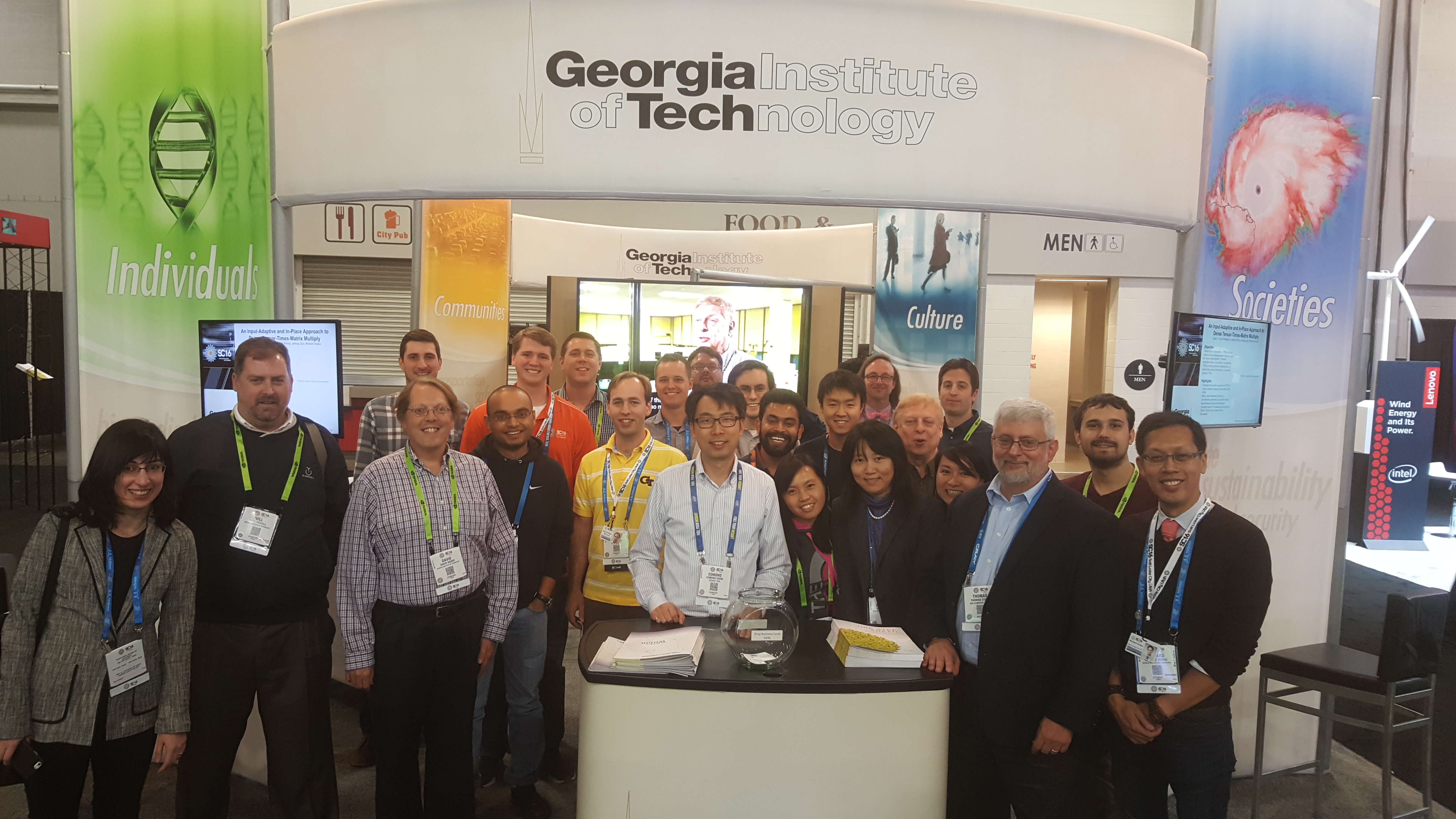
November 2016: Edmond Chow organizes the Georgia Tech show at the
annual ACM/IEEE SC (Supercomputing) Conference.
Here is a photo at our booth just before the
Gala opening. Over 40 faculty, research staff, and students participated
from across the Colleges of Georgia Tech.
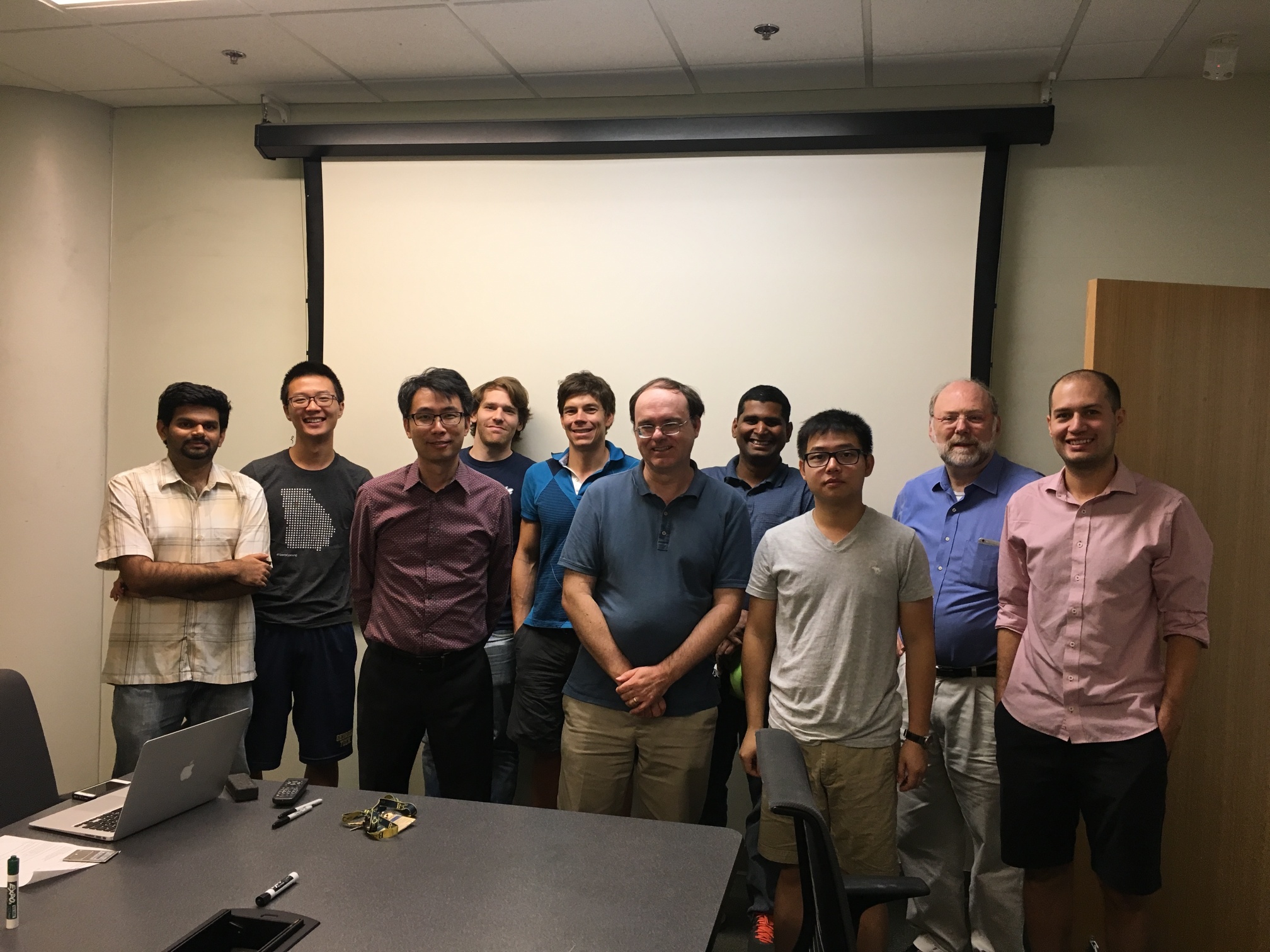
September 2016: Edmond Chow is leading a newly funded project on
asynchronous iterative methods for extreme scale computers. The $2.4 million
project over 3 years includes Georgia Tech, Sandia National Laboratories,
Temple University, and University of Tennessee. Here is photo from our kickoff meeting at Georgia Tech.
December 2014:
Xing Liu successfully defended his Ph.D. thesis. He now has a permanent
position at IBM T. J. Watson Research Center.
May 2014:
In collaboration with Intel, we have run our quantum chemistry code on
8100 nodes of Tianhe-2, the fastest supercomputer in the world!
April 2014:
Intel has awarded Georgia Tech an Intel Parallel Computing Center.
Edmond Chow will lead the center, which will focus on
Xeon and Xeon Phi algorithms and implementations for computational
chemistry and biochemistry. See the announcement
here. Our center website is
here.
How did I get Here?
I joined Georgia Tech in August 2010.
Previously, I worked at D. E. Shaw Research in New York (from 2005 to
2010) and at Lawrence Livermore National Laboratory in the Center for
Applied Scientific Computing (from 1998 to 2005). I've also taught
several courses at Columbia University as an Adjunct Associate Professor
in the Department of Applied Physics and Applied Mathematics.
I studied at the University of Minnesota (Ph.D., Computer Science,
minor in Aerospace Engineering, 1997).
My undergraduate studies were at the University of Waterloo in Canada
(Hons. B.A.Sc., Systems Design Engineering, 1993).
Co-chair (with Ali Pinar and Rob Schreiber),
SIAM Conference on Parallel Processing for Scientific Computing, Portland, OR, 2014.
Organizing Committee, SIAM Conference on
Computational Science and Engineering, Atlanta, GA, 2017;
Organizing Committee, SIAM Annual Meeting, Chicago, IL, 2014.
Algorithms Chair, Technical Papers Committee,
ACM/IEEE International Conference for High Performance
Computing, Networking, Storage and Analysis (SC12),
Salt Lake City, UT, Nov. 10-16, 2012.
Vice-Chair, Scientific Committee,
10th International Meeting on High-Performance Computing for Computational
Science (VECPAR 2012), Kobe, Japan, July 17-20, 2012.