located at :
georgia tech :
college of computing :
gvu center :
computational perception lab :
wall lab
and graphics
|

|
|
Matt Flagg, Ph.D.
mflagg @ cc.gatech.edu
Computer Science Ph.D. student (graduated Dec. 2010)
School of Interactive Computing, Georgia Tech
Graduate Research Assistant for Dr.
Jim Rehg
CV, Resumé (last updated 8/26/2009)
Update: I have a new website
I graduated and moved to San Diego, CA in October 2010 to work for Prof. David Kriegman and Dr. Satya Mallick at Taaz, Inc., a computer vision company focused on personal photo enhancement. I left Taaz in September 2012 to co-found PlayVision Labs, Inc., an entertainment company focused on gestural interaction with large displays. We are in stealth mode.
My research focuses on analyzing and synthesizing video for (a) video-based animations of humans, (b) computer-assisted oil painting and (c) shadow elimination and occluder light suppression in front-projected displays.
I am interested in computer systems which
can
interact naturally with people with little to no input devices such as mice
and keyboards.
I am also motivated by the prospect of entertaining people
through creative and gaming exercises. It is for this reason I co-founded PlayMotion [video1, video2], a company that sells
computer vision-based entertainment products and services. While there, I developed the computer vision system behind this Epcot attraction.
|
|
|
Research Projects:
|
Video-based Crowd Synthesis |
[ Ph.D. Dissertation | video ] |
|
Target Segmentation and Tracking |
[ video, 10.8MB, AVI ] |
|
Human Video Textures |
[ video, 74MB AVI, DivX codec ] |
|
Projector-Guided Painting |
[ video,
53MB, Quicktime ] |
|
Virtual Rear Projection |
[ video 1, 10.8MB, MPEG4,
video 2, 26.8MB ] |
| Multi-Planar Projected Displays |
[ video, 6.3MB, DivX ] |
| Real-Time Projector Calibration |
[ video, 13MB, MPEG4 ] |
Publications:
Journal Articles |
| |
Video-based Crowd Synthesis
Matthew Flagg and James M. Rehg
IEEE Transactions on Visualization and Computer Graphics (TVCG),
online pre-print published on November 30, 2012.
[ pdf, 17.7MB ]
|
| |
| |
Motion Coherent Tracking using Multi-Label MRF Optimization
David Tsai, Matthew Flagg, Atsushi Nakazawa, James M. Rehg
International Journal of Computer Vision (IJCV), November 2012, Volume 100, Issue 2, pp 190-202.
[ pdf, 8.4MB ]
|
| |
| |
Shadow Elimination and Blinding Light Suppression for Interactive Projected
Displays
Jay Summet, Matthew Flagg, Tat-Jen Cham, James M. Rehg, and Rahul Sukthankar
IEEE Transactions on Visualization and Computer Graphics (TVCG), Volume 13, Number 3, May/June 2007.
[ pdf, 0.37MB ]
|
Conference Papers |
| |
Motion Coherent Tracking with Multi-Label MRF Optimization
David Tsai, Matthew Flagg and James M. Rehg,
to appear in British Machine Vision Conference (BMVC) for ORAL presentation.
Aberystwyth, UK, August 2010.
[ pdf, 8.9MB | project website | Winner of Best Student Paper Award ]
|
| |
| |
Human Video Textures
Matthew Flagg, Atsushi Nakazawa, Qiushuang Zhang, Sing Bing Kang, Young Kee Ryu, Irfan Essa, and James M. Rehg,
to appear in Symposium on Interactive 3D Graphics and Games (I3D).
Boston, MA, February 2009.
[ pdf, 24MB | project page | video, 74MB AVI | featured on the back cover ]
|
| |
| |
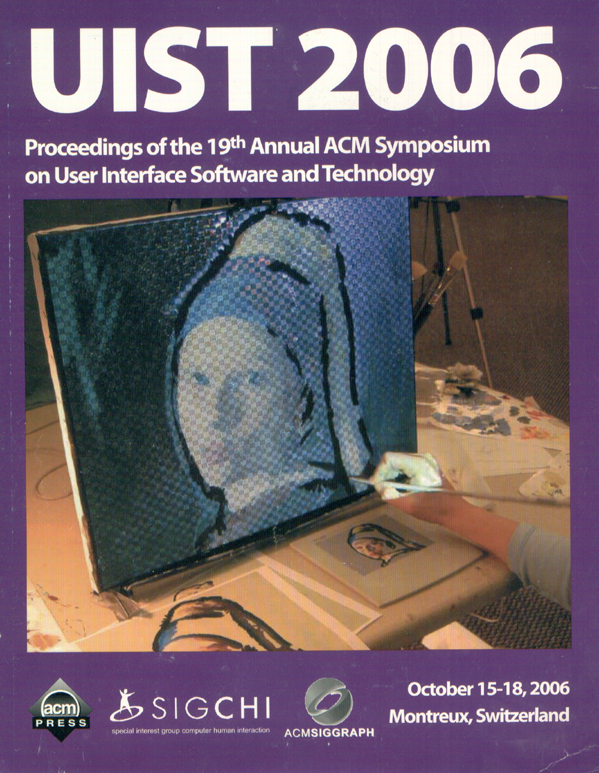
Projector-Guided Painting
Matthew Flagg and James M. Rehg,
Appeared in Proceedings of User Interface Software and Technology (UIST).
Montreux, Switzerland, October 2006.
[ pdf, 2.2MB, project page, PPT slides, 39MB, talk video,
featured on the cover! ]
|
| |
| |
GVU-PROCAMS: Enabling Novel Projected Interfaces
Jay Summet, Matthew Flagg, James M. Rehg and Gregory Abowd
Appeared in ACM Multimedia 2006.
Santa Barbara, California, October 2006.
[
pdf, 3.5MB ]
|
| |
| |
A Flexible Projector-Camera System for Multi-Planar Displays
Mark Ashdown, Matthew Flagg, Rahul Sukthankar, James M. Rehg,
Appeared in IEEE Conference on Computer Vision and Pattern Recognition
(CVPR 2004),
Jun. 2004.
[ pdf, 0.67MB ]
|
| |
| |
Projected Light Displays Using Visual Feedback
J. M. Rehg, M. Flagg, T.-J. Cham, R. Sukthankar, and G. Sukthankar,
Appeared in Intl. Conf. on Control, Automation, Robotics, and Vision,
Singapore, Dec. 2-5, 2002.
[ pdf, 0.56MB ]
|
Workshop Publications |
| |
Computational Support for Creativity via Capture and Access
Matthew Flagg, Christopher Skeels, James M. Rehg,
To appear in Computational Creativity Support held in
conjunction with ACM CHI 2009,
April, 2009, Boston, MA, USA.
[ pdf, 1.5MB ]
|
| |
| |
Improving the Speed of Virtual Rear Projection: A GPU-Centric Approach
Matthew Flagg, Jay Summet, James M. Rehg,
Appeared in IEEE International Workshop on Projector-Camera
Systems (PROCAMS) held in
conjunction with the IEEE International Conference on Computer Vision and
Pattern Recognition (CVPR 2005),
June, 2005, San Diego, CA, USA.
[ pdf, 1.2MB,
video, 10.8MB, DiVX
]
|
| |
| |
Robust Projected Displays for Ubiquitous Computing
Jay Summet, Matthew Flagg, Mark Ashdown, Rahul Sukthankar, James M. Rehg,
Gregory Abowd, Tat-Jen Cham
Appeared in Proceedings of Ubicomp Workshop on Ubiquitous Display
Environments,
September 2004.
[ pdf, 0.37MB ]
|
| |
| |
Increasing the Usability of Virtual Rear Projection
Jay Summet, Matthew Flagg, James M. Rehg, Gregory M. Corso, Gregory D.
Abowd, Appeared in IEEE
International Workshop on Projector-Camera Systems (PROCAMS) held in
conjunction with the International Conference on Computer Vision (ICCV 2003),
Nice, France, October 2003.
[ pdf, 0.70MB ]
|
Tech Reports |
| |
Shadow Elimination and Blinding Light Suppression for Interactive Projected Displays
Jay Summet, Matthew Flagg, Tat-Jen Cham, James M. Rehg, Rahul Sukthankar,
Technical Report GIT-GVU-06-02
[ pdf, 1.2MB
]
|
| |
| |
Oil Painting Assistance Using Projected Light:
Bridging the Gap Between
Digital and Physical Art
Matthew Flagg and James M. Rehg,
Technical Report GIT-GVU-05-35
[ pdf, 1.6MB
]
|
|
Virtual Rear Projection
Jay Summet and I are working on a system that
leverages two projectors to compensate for shadows and blinding light on users - we call this
virtual rear projection because the goal is to emulate a rear projection display using front
projection.
Watch this video (6.5MB, DIVX avi) of our demonstration, given at ICCV 2003 in Nice, France.
Here is a 1 page demonstration explanation
(PDF).
In the following publication, we report the results of a user
study and the use of markers to calibrate the system in real-time with the combined effort of
increasing the usability of virtual rear projection:
|
Increasing the Usability of Virtual Rear Projection
Jay Summet, Matthew Flagg, James M. Rehg, Gregory M. Corso, Gregory D. Abowd,
To appear in IEEE
International Workshop on Projector-Camera Systems (PROCAMS) held in
conjunction with the International Conference on Computer Vision (ICCV 2003),
Nice, France, October 2003.
(pdf, 0.70MB)
|
Jay Summet and I gave a GVU brown bag talk on Virtual Rear Projection on
March 18, 2004. You may
watch our presentation in streaming Quicktime and download slides.
Virtual rear projection requires calibration for geometric alignment of multiple projected displays
and photometric compensation for illumination differences caused by reflectance properties of the screen
and variations due to physical projector placement. Here are two images that illustrate these needs:
|
Geometric Alignment - Here you see myself and Jay Summet with two projectors projecting green grids on top of each other.
|
Photometric Calibration - Here you see myself with one projector projecting a black and white
checkerboard and the other projector projecting an inverted checkerboard. This configuration has no photometric
calibration applied; it is easy to tell the difference between projectors 1 and 2! With ideal photometric calibration,
we should see an evenly illuminated white square.
|
Projector-Camera System for Multi-Planar Displays
I helped create a system that calibrates a projected display onto
multiple planes. This system works by discovering the planar surfaces
using a form of structured light and calculating a set of metric-rectified
homographies. A metric-rectified homography is a mapping
from the projector to the plane that is precise enough to let someone
make metric measurements from each plane, such as distances on a map for
both a plan view and topographic view. Here is a technical report
on this system:
|
A Flexible Projector-Camera System for Multi-Planar Displays
Mark Ashdown, Matthew Flagg, Rahul Sukthankar, James M. Rehg
Intel Research IRP-TR-03-14, 2003.
(pdf, 0.64MB)
|
Real-Time Projector Calibration
I work with projectors and cameras to automatically correct keystone distortions. With our system,
the user may put four blue poker chips on a wall inside a region of projected light and the sytem
will automatically project inside the region defined by the poker chips. Furthermore, the system
will account for environmental disturbances such as movements of the projector, camera, or poker
chips. To learn more about this system, read the ICARCV publication:
|
Projected Light Displays Using Visual Feedback
J. M. Rehg, M. Flagg, T.-J. Cham, R. Sukthankar, and G. Sukthankar,
Appeared in Intl. Conf. on Control, Automation, Robotics, and Vision,
Singapore, Dec. 2-5, 2002.
(pdf, 0.56 Mb)
|
| |