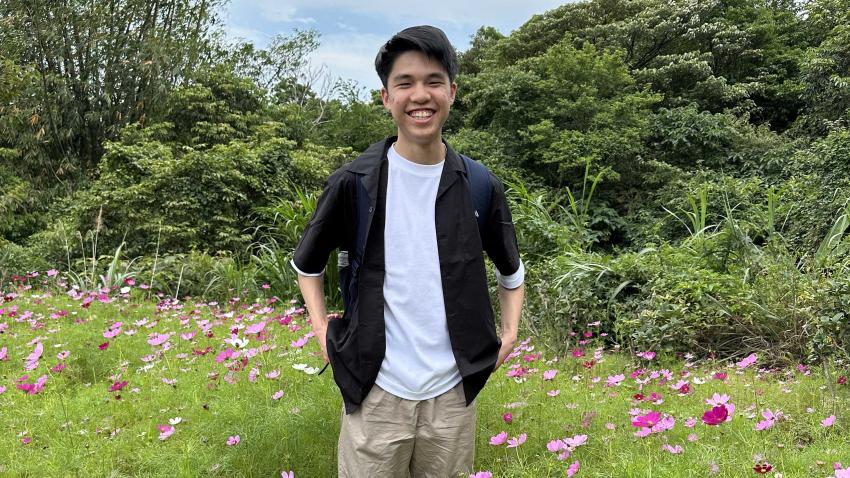
Bridging Computing and Biochemistry: A Q&A with Aaron Hung
For Aaron Hung, double majoring in computer science (CS) and biochemistry has enabled him to explore two fields that are increasingly interconnected through technology.
He decided to double major after developing an interest in the life sciences and realizing that much of his pre-med coursework could count toward the degree. Through research, Hung has seen how tools such as artificial intelligence and molecular modeling are transforming biological research.
What drew you to study computing?
In elementary school, I enjoyed the problem-solving aspects of math, but I wanted to find an area that was more directly applicable. Coding seemed like an interesting field where I could use some of that talent, so I tried it out, loved it, and never looked back.
What inspired you to pursue your second major?
Both of my parents are doctors, and they’ve instilled an interest in the life sciences. At one point, I was a CS and pre-med student and had already taken most classes for a second major. Similar to how I enjoy thinking about and learning how computer systems work, I’ve always been interested in the mysteries of the human body and in giving opportunities to those less fortunate.
I decided to double major in Spring 2025. I realized that while it would be possible with just a CS degree, pursuing medical research would be more challenging without the foundational knowledge I skipped by not pursuing a life sciences degree.
How do your two majors complement each other?
My two majors are very different from one another and provide almost no overlap. But together, they give me a complete view of both while providing variety in my classes. I get to take project-oriented CS classes, exam-heavy biochemistry classes, and exciting hands-on labs every week.
How have you managed the challenges of balancing two majors?
The coursework is the biggest challenge. There is a wide range of topics to learn about each day, so I need to manage my time well to work on projects and study for exams while balancing other responsibilities. Taking detailed notes helps me review course content quickly in preparation for exams and stay organized with to-do lists.
How do you plan on using your double major?
I’m focused on finding a job working on code I’m interested in, more than finding one that necessarily uses everything I have learned. But I wouldn’t mind working at a biotech company and applying my experience in high-performance computer simulations, AI/ML, and biochemistry.
What advice would you give to students considering a computing-related double major?
While it is hard and time-consuming, it’s worth the time and effort to pursue. Especially as AI gets better in all areas, being an expert in multiple areas helps you see and communicate with both sides in ways that AI cannot.
Is there anything unexpected you’ve learned from combining computing with another field?
The most surprising thing is seeing how much computational technologies impact other fields. In biochemistry, we learned about using models to predict protein structures that we couldn’t before. I’ve also used software to perform analyses that would otherwise require tedious manual work. This is only one example showing how programming has become an integral part of every field and how pursuing a second major can be valuable.