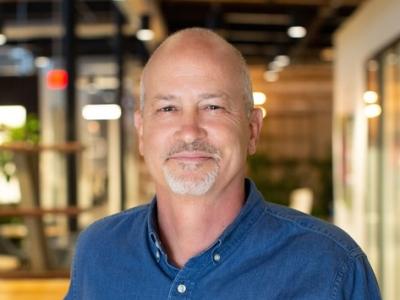
Computing Alumnus Finds New Purpose Beyond the Boardroom
Russ Holt (B.S. ICS 1983) has had two careers. In the first, he climbed the ranks at NCR and Dell, eventually leading a multi-billion-dollar enterprise systems division. In the second, he devoted himself to working for his church and a nonprofit ministry serving a local congregation and the city.
Now, in what he calls his “fourth quarter,” he and his wife plan to spend time with family, travel the world — and, of course, keep working, if only part-time, as the operations director for the nonprofit ministry connected to his church.
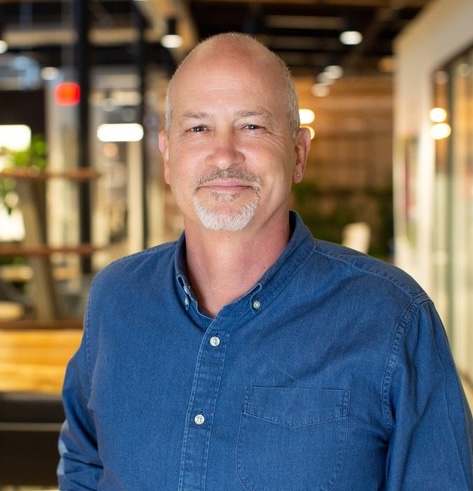
“I don’t think retirement is a biblical term,” he said. “A friend of mine referred to it as being repurposed. I suspect that as long as I have breath, I’ll work within this calling to have an impact for good.”
Holt says his computing education at Georgia Tech prepared him for every phase of his life.
“I love the challenges of problem-solving and figuring out puzzles,” Holt said, “how to make things work and then debugging it to find out things that are wrong. They’re just skills you carry through life.”
The First Quarter: Education
Holt began his college career at the U.S. Air Force Academy. While there, he met the woman who captured his heart. But because cadets weren’t allowed to marry, he dropped out of the academy to marry his wife and enrolled at Georgia Tech in 1981.
Both Holts worked hard, lived in married-student housing, and watched their pennies. That didn’t keep them from making good memories, though.
“We would watch Thursday night movies in the engineering building auditorium,” Holt said. “It was only 25 cents to attend. That theater was a kind of respite for us, something we could afford.”
His other favorite places on campus were the library and the basement of the Information building, which housed the IT department for the then-called School of Information and Computer Science.
“I was just thinking about how far things have come with AI now,” he said. “I actually had a punch card class.”
The Second Quarter: Computing Industry
Holt graduated from Georgia Tech with highest honors in September 1983 and accepted a position at NCR. He flourished there, rising from programmer to Vice President and General Manager of NCR’s small-business computer division in just 12 years.
In the late 1990s, NCR began divesting its computer business. After 14 years with NCR, Holt took a job at Dell in 1998, a role that came with two challenges. First, he was a software expert, yet Dell put him in charge of a hardware team. Second, he took a step down in rank for the job.
“Within six months, I became the vice president and general manager of their entry-level server division,” he said. “In 2002, I became a member of the executive committee.”
His role expanded to vice president and general manager of the enterprise systems division, covering both servers and storage. The 2002 Network World annual list, "50 Most Powerful People in Networking," included Holt and a Dell colleague, both co-vice presidents and general managers of Dell Computer Corporation’s Enterprise Systems Group.
During this period, Dell significantly accelerated its push into high-density rack servers, networking switches, and enterprise Linux deployments. Rather than listing them individually, Network World grouped them by their collective impact on corporate infrastructure and named them among the final 50.
While at NCR, Russ served as a Georgia Tech contact involved in NCR recruiting. He assumed a similar role after he settled into Dell. Holt was invited to serve on the College’s Advisory Board in 2003 and remained on the board until 2015, serving as the board’s chair for the last two of those years.
His career was flourishing, but around 2002 he felt called to leave it all behind.
The Third Quarter: Ministry
When he was in his early 30s, Holt wrote a mission statement for his life as part of a broader drive to live with purpose.
It is my mission in life to experience sustaining joy by living an abundant life spiritually, socially, industrially, and financially.
Holt had been a devout Christian since childhood, and as he reached new career heights, he began to wonder whether it was time to give back by serving in ministry and living out his faith in practical ways.
“There came a point in my career when my wife asked me, ‘When is enough enough?’” he said. “Was I going to have a life that was all about me and what I could accomplish, or about giving back? We made the decision together to go into ministry.”
While at NCR, the couple had spent 14 years attending Gateway Church in Columbia, South Carolina, a Southern Baptist Church. In 2006, their pastor was building a leadership team. Twenty-three years after graduating from Tech and after a little over 8 years with Dell, Russ stepped into ministry. Russ Holt jumped in, not as a preacher, but to use his professional skills to help the congregation.
After three years with Gateway Church, he joined Crossroads Church, a non-denominational church that had founded a non-profit organization focused on reaching the city with the gospel – the good news of Christ. The non-profit encourages churches in the city to work together, to collaborate rather than compete, and to mobilize their people where they live, learn, work, and play, so they have the opportunity to love and serve their neighbors and colleagues and to share their faith with those who are far from God but close to them.
He became the church’s executive pastor and served as the operations director for the non-profit. These roles were similar to those of a chief operating officer in industry. He helped select and implement management software as part of the church’s operations. This included designing the system’s workflows to improve processes within the church and the non-profit.
“The software industry is pretty active on the church side as well,” he said.
Crossroads Church later connected with other churches across the U.S. and, together, founded a nonprofit network operating in more than 100 cities across the U.S. and Canada. Rather than serving in traditional pastoral roles, he leaned into the same strengths that had carried his corporate career: administration, finance, staffing, strategic planning, and process design.
For example, he built workflow diagrams for how the church should handle everything from guest follow-up to staff hand-offs, applying engineering discipline to congregational life. At the nonprofit, he held similar roles, including assisting other churches with their operations and strategic planning.
His ordination came later, prompted not by a career milestone but by his youngest son's request that he officiate his wedding. After 15 years on staff, Russ began to sense another transition in his calling and purpose.
The Fourth Quarter: Service
Holt describes his life in roughly twenty-year arcs. The first twenty-two years prepared him for adulthood; the next twenty-three were spent in the computing industry; and the following twenty were devoted to full-time ministry. Now 65, he is “re-purposing” to focus on family and the non-profit ministry.
He and his wife have three adult children, seven grandchildren, and have been married for forty-five years. This year, they are taking a river cruise down the Rhine, and next year, they're headed to the Cotswolds with Georgia Tech Alumni.
He is not stepping down from his mission, however. Holt continues to serve as an elder with Crossroads Church and, in his part-time role as operations director, will continue serving with the non-profit network, which now has 37 active city movements across North America.
“It wasn’t a drastic shift,” he said. “It was more of a, ‘I want to drop the HR, the administration, the business financial side of running the church, and just dedicate half my time, 20 hours a week, to this nonprofit.’”
Although he divides his life into quarters, Holt says there’s been a strong thread running through it.
“My identity is wrapped up in my faith in Christ,” Holt said. “I feel like my time at Tech and in industry was preparing me with skills I could apply to ministry – to helping the church and serving ministry leaders.”