
Endowment in Honor of Rich DeMillo

There are people who make careers in computing, and there are people who shape the field. Richard DeMillo is the latter — a scientist, builder, and change agent across a five-decade career. DeMillo has served at the highest levels of industry, government, and academia, asking the same question each time: what needs to change, and how can we change it?
DeMillo helped build the early architecture of the internet. He transformed how the U.S. Department of Defense tests software. He led Hewlett-Packard through a pivotal era as its first Chief Technology Officer. He exposed vulnerabilities in American voting machines before most people knew they were vulnerable. He reimagined what a research university could do for the hundreds of millions of people it would never enroll.
Many Careers, Many Ideas
Before DeMillo arrived at Georgia Tech, he had already done several careers’ worth of consequential work.
In the 1970s, he co-developed Program Mutation, a foundational software testing methodology still in wide use today. In 1977, he collaborated with Lawrence Landweber to create THEORYNET, an early store-and-forward computer network that became a direct predecessor of NSFNet and therefore the internet. His 1979 paper “Social Processes and Proofs of Theorems and Programs” has been reprinted dozens of times and was recently recognized as one of the 50 most influential papers in the history of computer science.
At the National Science Foundation, he directed the Computer and Computation Research Division. At the U.S. Department of Defense, he directed the Software Test and Evaluation Project, where he shaped the DoD’s foundational policy for testing software-intensive systems. At Bellcore (later Telcordia), he led the development of e-commerce technologies now so ubiquitous they are invisible.
At Hewlett-Packard, he became the company’s first Chief Technology Officer, leading HP’s introduction of a new processor architecture, its corporate trust and security strategy, and its entry into open-source software — a move that was, at the time, far from obvious.
When DeMillo returned to academia, he brought a practitioner’s understanding of what computing actually does in the world — and an innovator’s mindset to a young college facing many challenges.
Transforming the College
DeMillo became dean of the College of Computing in 2002. In seven years, he launched three new schools, seven new degree programs, three international programs, and two new research centers. Georgia Tech’s graduate computer science ranking rose from 14th to 9th nationally. Annual expenditures doubled. He oversaw the groundbreaking and construction of the 200,000-square-foot, $80 million Christopher Klaus Advanced Computing Building.
The most lasting thing DeMillo built, however, was a reinvented undergraduate computer science curriculum. The Threads program allows students to choose two distinct concentrations and weave them into a degree that is genuinely their own — producing graduates who can think across disciplines, adapt to problems that don’t have names yet, and claim ownership over their own intellectual formation.
Thomas Friedman wrote about Threads in his 2005 book, “The World Is Flat,” recognizing that the world increasingly requires people who can work horizontally, across disciplines and domains, on a platform that rewards synthesis over specialization.
“I’ve always been impressed with how the students want to tell you about their Threads," said Ellen Zegura, Fleming Professor of Computer Science. "They get some agency, and the different Threads have different personalities and cultures. Students will put their Threads in their signatures.”
When Computing Meets Democracy
As dean in the early 2000s, DeMillo saw voting technology burst into national headlines after the contested 2000 presidential election. His work on election and voting system security has been cited in dozens of court cases, including important federal cases deciding constitutional issues in election law. He has served as a foreign election observer for the Carter Center and is a member of the State of Michigan Election Security Commission.
This is what a cross-disciplinary computing education produces — people who see a societal problem and understand, at a technical level, exactly how to address it.
The Democratization of a Degree
After stepping down from the deanship in 2009, DeMillo published “From Abelard to Apple: The Fate of American Colleges and Universities” — a diagnosis of an institution in crisis — and then founded the Center for 21st Century Universities (C21U) to test the cure.
C21U is a laboratory. One of its most consequential experiments was Georgia Tech’s early partnership with Udacity in 2012, which helped catalyze the Online Master of Science in Computer Science (OMSCS). At launch, OMSCS offered a full Georgia Tech master’s degree for under $7,000, compared to more than $40,000 per year on campus. Forbes called it “the greatest degree program ever.” Tens of thousands of working adults — many from underrepresented backgrounds, many outside the United States — have since earned that degree.
“Rich saw how education was fundamentally going to change. He was a pioneer.” — Mustaque Ahamad, Interim Chair, School of Cybersecurity and Privacy
DeMillo’s second book, “Revolution in Higher Education: How a Small Band of Innovators Will Make College Accessible and Affordable” (MIT Press, 2015), won the 2016 PROSE Award from the American Association of Publishers. He was named a Lumina Foundation Fellow and is a Fellow of both the ACM and the AAAS. He holds the Charlotte B. and Roger C. Warren Chair in Computing.
The Effort Continues
DeMillo’s work changed computing education, but there is still a long way to go. Access to high-quality computing education remains deeply unequal. The security of democratic infrastructure remains fragile. The structures of higher education face unprecedented challenges. The pipeline of researchers willing to pursue hard, consequential, cross-disciplinary problems depends entirely on whether we give the next generation the freedom and resources to pursue them.
The faculty who will reimagine computing for the AI era are building their careers right now. What they need is what DeMillo built institutions to provide: the freedom to think originally, across disciplines, about problems that matter. That is what this endowment is for.
Richard DeMillo will retire in December 2026. We will honor him at a celebration on October 21, 2026 — not simply as the conclusion of a remarkable career, but as a public declaration that the work he began will continue. At that event, we hope to announce that the College has received significant commitments to establish this major endowed fund in his honor.
We are deeply grateful for your consideration. To make a commitment or learn more, contact Jason Zwang at jzwang3@gatech.edu.
Letter from Dean Vivek Sarkar
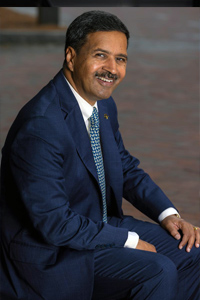
Rich DeMillo has shaped this College in ways that are still unfolding. The programs he built, the students he inspired, and the faculty he mentored have left a mark on Georgia Tech — and on the field of computing — that will endure long after his retirement this October. It is a privilege to write this letter in support of an effort to honor that legacy in a meaningful and lasting way.
Letter from Mustaque Ahamad

I joined Georgia Tech in 1985, arriving at the School of Information and Computer Science (ICS) when Rich DeMillo was already a key member of its faculty. Over the next four decades, ICS transformed itself into a world-class college of computing ranked among the very best. It is not hyperbole to say that Rich’s bold vision had a great deal to do with what the College has become. He has been a mentor and colleague who has profoundly influenced my professional journey — and the same is true for so many colleagues here and beyond.