52-Year-Old Entrepreneur Has New Outlook After Completing Ph.D.
52-Year-Old Entrepreneur Has New Outlook After Completing Ph.D.
Mizan Rahman knows there’s much that academia and industry can learn from each other.
He’s living proof of it.
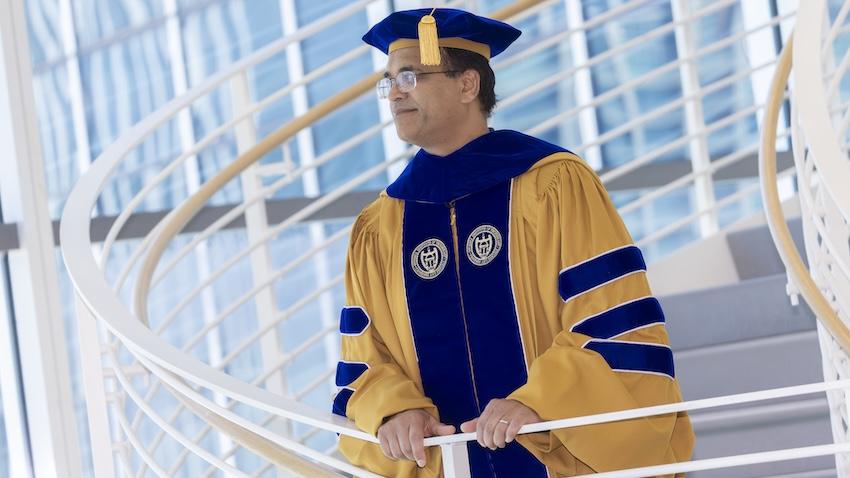
The 52-year-old entrepreneur will receive his Ph.D. in human-centered computing (HCC) as he walks across the stage on Thursday at Georgia Tech’s Spring 2026 Ph.D. Commencement.
When Rahman was accepted into the HCC Ph.D. program, he’d already founded three successful tech startups and was an angel investor in numerous others. He also earned a master’s in computational science and engineering from Georgia Tech in 2013.
Rahman took on the challenge of a Ph.D. because he’s always been in pursuit of a holistic view of technology. One perspective he said he needed to understand was that of the end user.
“I’d already done computer science and computational science and engineering, so I wanted to look at the human dimension, the user’s perspectives, and society,” Rahman said. “You’ve got to build technology that fits into our human dynamics.”
Rahman’s journey began as an undergraduate in chemical engineering at Miami Dade College and Florida Atlantic University. He switched to computer science after his roommate, also a CS major, showed him some programming he had been working on.
“I couldn’t sleep after that,” Rahman said. “I was writing software all night. I loved solving problems through technology.”
Early Success
Rahman invented BayBuilder, a strategic sourcing automation technology, in 1999. The software was adopted by major Fortune 500 companies. Rahman estimates it has saved these companies $1 billion in procurement spending.
Baybuilder was acquired by a NASDAQ-listed firm in 2001, and he was ready to start his next company.
“I’ve been an entrepreneur as far back as I can remember,” Rahman said. “I was born with it. If I saw something that didn’t exist, I created it.”
After relocating to Atlanta, Rahman founded a new company, M2SYS Technology. Governments around the world used the company’s innovative identity technology to automate processes and deliver efficient services to citizens. M2SYS also worked with the CDC to treat HIV in Haiti and Zambia, as well as many U.S. hospitals, including Grady Memorial in Atlanta, to protect patients from fraud and receiving the wrong treatment.
Rahman’s most recent startup, CloudApper AI, introduced a new system architecture that generates secure software requiring minimal ongoing maintenance. His non-biased algorithm, which he created during his Ph.D. for CloudApper, is now used by major companies to streamline automated resume analysis and candidate scoring.
Living in Two Worlds
Rahman began his Ph.D. in 2021, but he kept his new venture to himself and his family. He didn’t tell his employees he was pursuing a Ph.D., and he didn’t disclose his industry background to his fellow doctoral students.
“I kept the other side of me far away,” he said. “The people who knew, they knew, but I purposefully didn’t discuss my outside activities and experience. I wanted to fit in, and I think I was able to do that.”
When Rahman was at his company, he was a CEO and entrepreneur, and when he was at Georgia Tech, he was a researcher. But what he was learning as a researcher began to change how he perceived his business.
“I wanted to be a researcher and think like a researcher and not just always think about sales and marketing,” he said. “I started bringing in more ideas about how the user should be thought of in our products. I’m sure they were wondering why I was emphasizing that so much, but it was because I was applying what I was learning in my Ph.D.
“Now I’ve been on both sides, I want to be connected to both in the future, applying research principles and practices in product development and innovation.”
Building Community Through Makerspaces
When it came time for Rahman to choose a subject for his dissertation, he returned to his roots and looked for ways technology can support young entrepreneurs and their startups. That’s when he began conducting research in makerspaces.
“I wanted to find out how we can bring innovation to a scale where anybody can participate,” he said. “I saw this happening in makerspaces where regular people learn, collaborate, and build products and companies from scratch. I saw that the community at large is facing a sustainability crisis.”
Rahman argued in his dissertation that makerspaces can play a significant role in local innovation. When people struggle to survive, it disrupts communities in numerous ways.
Rahman details four studies conducted over three-and-a-half years that show how socio-technical factors drive organizational sustainability in makerspaces and how AI tools can foster an innovative culture within them.
“The compelling thing about his research is that he shows that people come to makerspaces for the tools, but they stay for the people,” said Rosa Arriaga, associate professor and Rahman’s advisor.
“He has plenty of work from his ethnographic research that shows that a makerspace can have all the tech and resources, but if there isn’t cohesion among the people, there’s a problem.”
It Takes a Village
Rahman is the first to admit that it’s not possible for one man to run a company while pursuing a Ph.D. He needed a community. This starts with his family. His wife, Mohu Sultana, now serves as interim CEO of M2SYS and has supported Rahman throughout his Ph.D. research.
The Georgia Tech community has been part of Rahman’s life in some way since he started his career.
Sultana holds a bachelor’s degree in computer science from Tech, and their daughter, Malisha Rahman, is graduating this week with a bachelor’s in economics and international affairs. Malisha Rahman has also been accepted into the HCC program and will begin her Ph.D. in the fall.
Rahman said that any student who wants to create a tech startup will have an advantage from access to Georgia Tech’s network.
“The Georgia Tech startup community is fantastic,” he said. “There is a tremendous amount of knowledge here, and the research community can help shape the next big thing. We have CREATE-X, a place where you can find mentorship from faculty who started in industry. You’ll learn things I wish I knew before I started.”