GT Computing Students Find Community, Opportunity at Tapia Conference
For Georgia Tech computer science (CS) students Summer Abramson, Cindy Muniz, and Anika Gaddam, attending the ACM Richard Tapia Celebration of Diversity in Computing Conference was about more than building resumés or exploring careers.
It was a chance to find community, encounter new ideas, and see a place for themselves in the future of computing.
The Sept. 16-18 conference at the Hyatt Regency Atlanta brought together students, researchers, educators, and industry professionals from across the country to advance diversity in computing.
The College of Computing had a strong presence throughout the conference, with Vivek Sarkar, John P. Imlay Jr. Dean of Computing, delivering welcoming remarks at the opening session and several College faculty, researchers, and leaders participating in panels and other programming.
Unprecedented student demand
The College has funded students to attend Tapia for more than a decade, typically covering attendance for about eight graduate students. However, with Tapia in Atlanta this year, a record number of students sought registration support from the College.
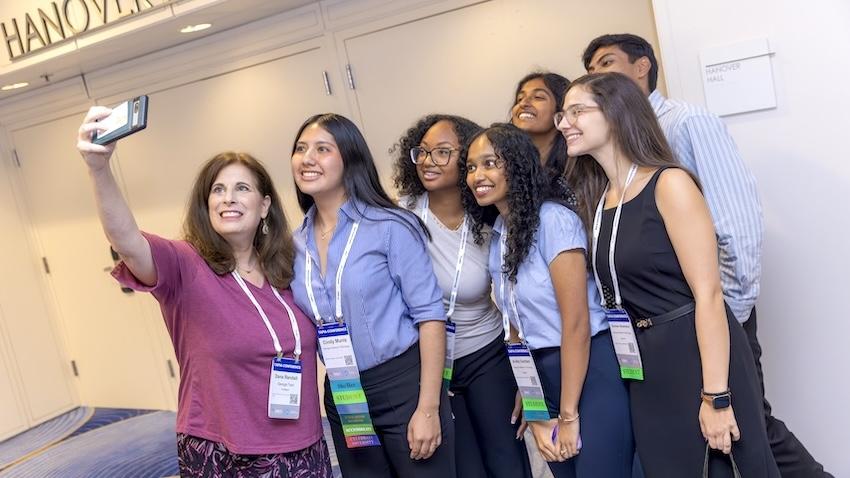
To manage the demand, Associate Dean of Access and Advancement and Regents’ Professor Dana Randall established the GT Computing Tapia Award. She led a small committee that reviewed 54 student applications and selected 17 for conference registration support.
“Of course, we wish that the College could have covered registration for all of the students who applied,” said Randall. “Tapia is an incredible opportunity for students to discover their community as they develop a richer understanding of where a career in computing can take them.”
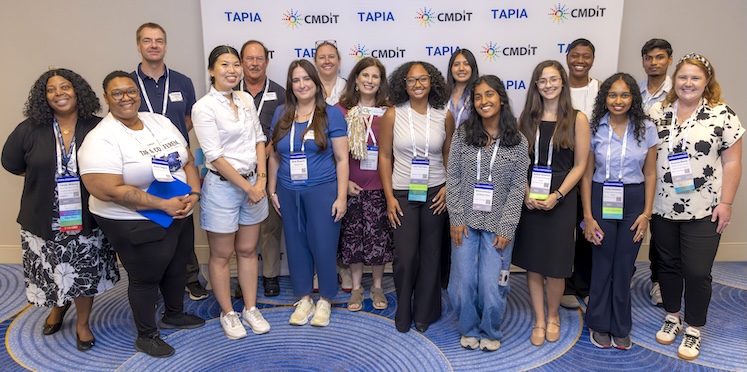
The 17 GT Computing Tapia Award winners were joined by eight students from the Online Master of Science in Computer Science program, and about 10 student volunteers, for a GT Computing contingent of approximately 35 students.
Connecting to community
For Abramson, a CS master’s student whose research focuses on inclusion in computing, the conference offered an opportunity to connect her academic interests with a broader community.
“Tapia was especially meaningful to me because much of my research focuses on inclusion in computing and on creating spaces where everyone feels welcome,” Abramson said. “Attending Tapia allowed me to network and to see how others in my field are working toward those goals.”
But most of all, Tapia reinforced Abramson's sense of belonging.
“The biggest lesson I learned from this conference is that there will always be a place for me at Tapia where I can be myself,” she said. “The best way to carry that legacy forward is to create the same space for others in my own community.”
The Tapia experience provided Muniz, a second-year CS major, with an equally personal perspective.
As a Latina student, Muniz said she remembered attending a first-year seminar in which the student panel didn’t include anyone who looked like her. At Tapia, she found a diverse, supportive community focused on helping students succeed.
“Their continued advocacy for diversity in the computing industry was inspiring,” Muniz said, “and they provided me with numerous resources so I can work toward my future.”
Muniz made the most of these resources by participating in resume review sessions and speaking with recruiters. She also drew inspiration from a presentation by Omar Florez, team lead for LatamGPT, a large language model for Latin America.
As a bilingual student assistant, Muniz saw the potential for technology like LatamGPT to help address representation and information gaps for communities that may lack access to college application resources.
Gaddam, a third-year CS major, also appreciated Tapia’s emphasis on diversity in computing.
She found the conference particularly relevant to her academic and professional interests. A session on the Evolution of Software Engineering with AI directly connected to her coursework and internship experience, while a career panel featuring engineers from Meta and Netflix offered insight into career growth for people of color in technology.
“Being in a room where most of the attendees and speakers didn't match the default image of who works in AI reinforced something I already believe,” said Gaddam.
“The industry needs more people who lead with empathy and intuition, not just technical throughput.”
GT Computing at Tapia
The College’s presence extended beyond student attendance. Along with Sarkar’s opening remarks, faculty, researchers, and students also participated in conference programming.
Kamau Bobb, senior director of Georgia Tech’s Constellations Center for Computing Education, co-headlined a session with data scientist and Tapia co-founder Valerie Thomas. The two discussed artificial intelligence (AI) and its impact on underrepresented groups, which is the subject of Bobb’s recent book, The Bullwhip’s Algorithm: Artificial Intelligence and America’s Racial Caste System.
Additional programming contributions from the GT Computing community included:
- Reeda Shimaz Huda, a first-year Ph.D. student in human-centered computing, participated in a panel discussion titled Cultivating Tomorrow’s Innovators: The Transformative Power of Undergraduate Research.
- Alex Cabral, a former postdoctoral fellow in the Ka Moamoa Lab at Georgia Tech, and Josiah Hester, an interactive computing associate professor, participated in a Birds of a Feather session titled Impact-Focused Research in Computing: Publishing, Career Paths, and Community-Building Without Losing Your Values.