From Industry to Impact: A Ph.D. Journey in Cybersecurity
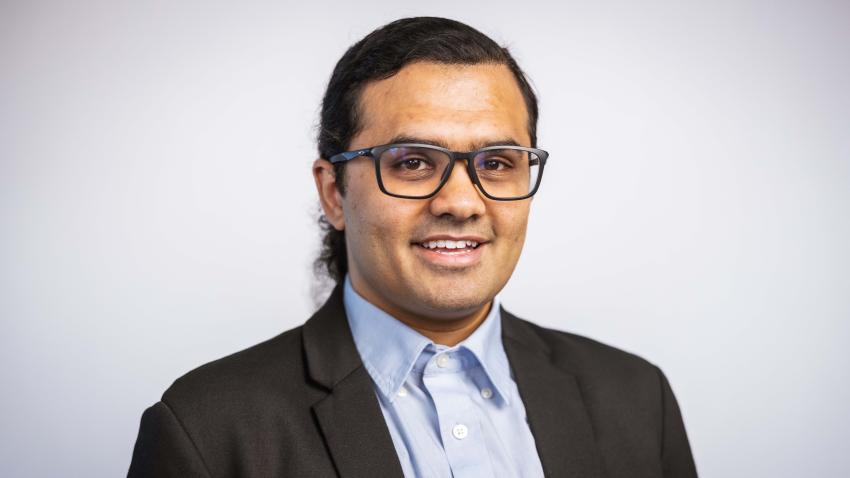
After earning a master’s degree in 2016, Abhishek Bhaskar’s plan was straightforward: build a career in industry and stay close to research without committing to a doctoral program.
That plan lasted about three years.
“I initially thought I’d just continue in research without a Ph.D.,” Bhaskar said. “My advisor encouraged me to stay, but I wanted to experience industry first.”
In addition to perspective, working outside academia offered Bhaskar clarity. Over time, he found himself drawn back to the kind of deeper, more impactful research he had glimpsed during his graduate studies. Watching colleagues with doctoral degrees tackle complex problems reinforced his decision.
“I realized I missed research,” he said. “And seeing the kind of work Ph.D. graduates were doing motivated me to apply.”
That decision led him to Georgia Tech, where the strength of its cybersecurity and network security research stood out. The program’s interdisciplinary approach was a major draw.
“Some schools are strong in one area,” he said. “Here, there’s collaboration across domains. That was important to me.”
When Bhaskar arrived, the School of Cybersecurity and Privacy had not yet fully taken shape. Research groups, including the Institute for Information Security and Privacy, were already active, but the school's formal structure emerged during his second year.
Working with his advisor, Paul Pearce, Bhaskar shifted his research focus from binary and static analysis to network security, a transition that required both adjustment and curiosity.
“I wanted to move into something with more direct real-world impact,” he said.
This led him to work on censorship measurement, internet security and privacy, areas where technical findings can have global implications. With guidance from Pearce and support from other faculty working in similar areas, he quickly found his footing.
His favorite research project however, was in fact his first.
In earlier research, unexplained anomalies had appeared in measurement data. At first, the assumption was that they stemmed from geolocation issues. However, after digging deeper, Bhaskar uncovered a different cause: routing changes.
“That discovery showed that routing can significantly affect measurement results,” he said.
What began as a narrow investigation turned into a broader insight. One that reshaped how those measurements could be interpreted.
Along the way, other milestones followed, including his first paper accepted to a top conference.
“That was a big moment,” Bhaskar said.
But beyond publications and research breakthroughs, it’s the day-to-day experience of doctoral life that made the strongest impression.
“The camaraderie stands out the most,” he said. “Especially during deadlines. Everyone is working hard, but you still take time to step away, talk, and support each other.”
That sense of community extended beyond his own lab. Interactions with neighboring groups and researchers in fields like cryptography broadened his perspective and shaped his approach to problems.
“The way different groups think about problems is really valuable,” he said.
Outside the lab, Atlanta played its own role in the experience. From sporting events to concerts, the city offered a balance to the intensity of research.
“There’s a lot to do,” Bhaskar said. “I tried to take advantage of that.”
Now, as he prepares to graduate, the next chapter is already in motion. Bhaskar will move to the West Coast for a post-doctorate security research role at Stanford University, following a summer internship that offers time to reset before the transition.
“Abhi's work is excellent,” said Pearce. “During the course of his Ph.D. he discovered important underlying phenomena that influence how we measure and understand internet censorship and end-to-end network behaviors broadly.”
“He's an outstanding researcher and community leader, and while his contribution as a student to my group and SCP will be missed, we're excited about what he accomplished and his next steps!”