Undergrads’ Team Phoenix Wins Top U.S. Honor at International Supercomputing Competition
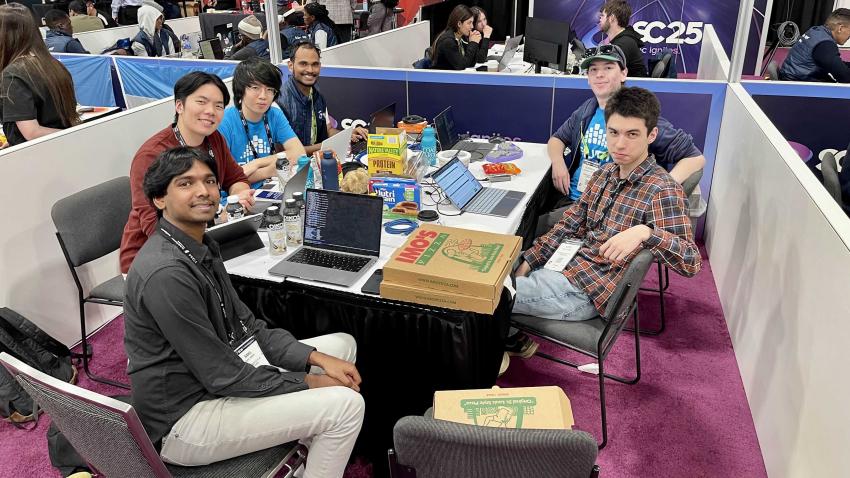
Georgia Tech’s Team Phoenix secured first place among U.S. teams at the 2025 Indy Supercomputing Challenge (IndySCC), an international competition that tests high-performance computing (HPC) skills through real-world scientific applications.
With a long track record in competitive high-performance computing, the group has competed in all three major annual supercomputing contests - SCC, ISC, and IndySCC - and has participated in IndySCCevery year since 2023.
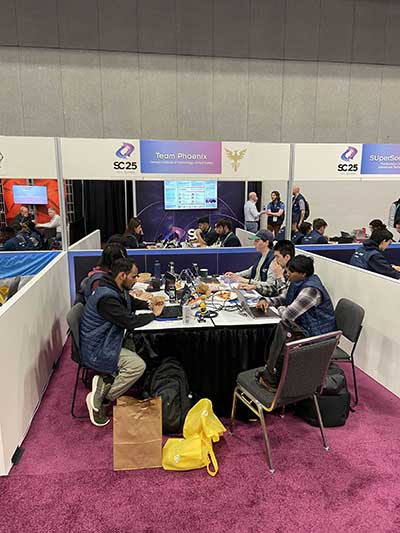
The team operates through Georgia Tech’s Vertically Integrated Projects (VIP) program, which provides students with hands-on experience in HPC systems, AI-driven workloads, advanced architectures, and large-scale software development. Students work in teams to build, configure, and run complex applications, strengthening their skills in parallel and distributed computing, communications frameworks, and software engineering.
The effort is supported by a strong network across Georgia Tech, including the College of Computing, the Partnership for an Advanced Computing Environment (PACE), and Technology Services and Operations (TSO). Additional funding and logistical support are provided by VIP, the Institute for Data Engineering and Sciences (IDEaS), PACE, the College of Computing, and the Center for Scientific Software Engineering (CSSE).
This year’s six-member undergraduate team included computer science majors:
- Alexander Ichetovkin
- Alex Kim
- Aiden Lambert
- Sahil Samar
- Seth Yiming Shi
- Venkata Sai Aditya Reddy Devarapalli.
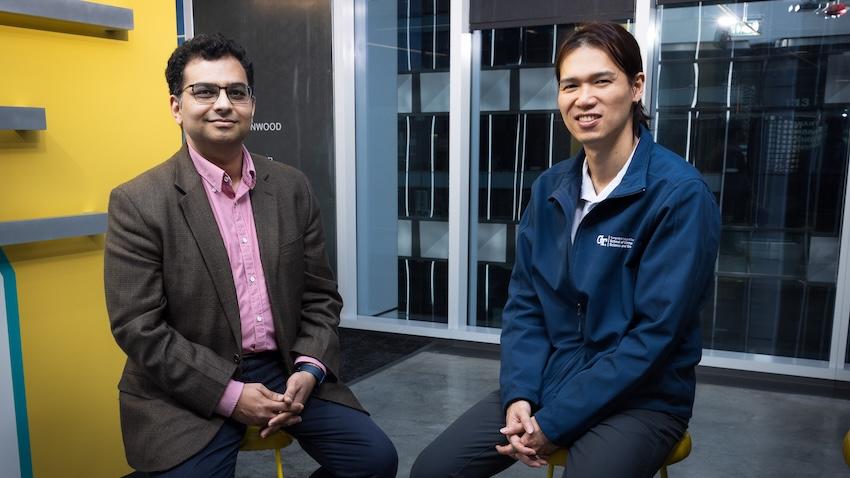
The team was led by College of Computing Professor Richard Vuduc, with support from graduate mentors Charles Lindsey and Jay Saraha, PACE faculty and staff mentors Jeff Valdez and Aaron Jezghani, and Computational Sciences and Engineering Research Technologist Will Powell.
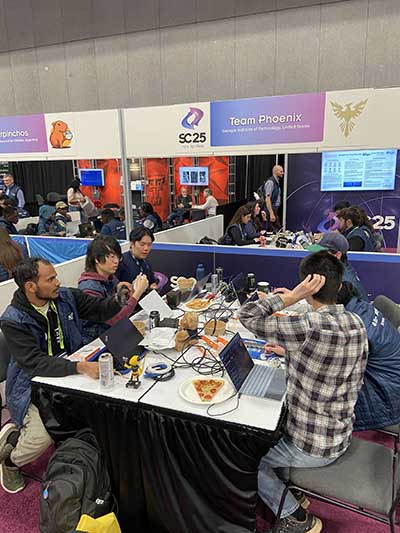
“An advantage we had this year was the return of two members from last year’s team, Alex Kim and Alex Ichetovkin,” Lindsey said. “Their experience led to improved strategies for the 24-hour and 48-hour competition phases.”
The competition has two parts: a 24-hour performance test and a 48-hour challenge in which teams run a set of real-world scientific programs. One of the programs is kept secret until the competition begins, adding an extra layer of difficulty.
During the 48-hour challenge, Team Phoenix divided into small groups, with each pair of students focused on a single program. This approach enabled the team to work faster, solve problems more efficiently, and make the most of their limited computing time.
“A term such as ‘supercomputing’ may seem daunting or abstract, but we require no previous experience and welcome students from all disciplines,” Lindsey said.
Applications for the next IndySCC are open through May 2026, and Team Phoenix invites students to join the VIP program.