AI Improves Diabetes Care One Decision at a Time
Public health systems often face a difficult challenge when time, funding, and resources are limited: who should receive care first? These decisions are complicated further by differences in patient needs, disease progression, and social factors like access to care.
A team of computer scientists and doctors led by Georgia Tech aims to change that. Using a system of artificial intelligence (AI) models, the team can help clinicians deliver the right intervention to the right patient at the right time.
Their system uses Restless Multi-Armed Bandit (RMAB) models. While the name is technical, the idea is simple. The RMAB framework helps decision-makers choose the best actions over time when conditions are complex and constantly changing.
This project will tackle Type 2 Diabetes (T2D), building on previous experience expanding RMAB models to support maternal health care in India. Success on this front could lead to treating other chronic illnesses, like hypertension, heart disease, kidney disease, and mental health.
Recognizing the RMAB system’s potential, the National Institutes of Health (NIH) awarded the group an R01 grant. The award will fund the project with $1.2 million through 2029.
“Our goal is to address the immense challenge of allocating limited health intervention resources in optimal ways,” said Kai Wang, an assistant professor in the School of Computational Science and Engineering (CSE).
“By leveraging rich contextual data and accounting for social determinants, we envision RMAB models that empower health centers to customize interventions to individual patient profiles. Ultimately, this advances precision medicine and ensures equitable healthcare access for diverse populations.”
Addressing Type 2 Diabetes
T2D is a diabetes condition where the body resists insulin or doesn’t produce enough to regulate blood sugar levels. Left unmanaged, high blood sugar leads to severe health problems like heart disease and stroke, damage to organs like eyes and kidneys, nerve damage, infections, and ulcers.
T2D is challenging to treat because patients have different ages, genetics, lifestyles, and body composition, all of which affect the progress of the disease. Social factors, like transportation and family support, matter just as much as biology to treat the disease.
For these reasons, patients who get the same medications may get very different results. While treatment plans now incorporate new GLP-1 drugs, they remain expensive and difficult to distribute equitably.
“Diabetes is a great example of a complicated, multi-faceted problem. It is a natural playground for the kind of high-dimensional machine learning algorithms we want to build and deploy,” said School of CSE Professor B. Aditya Prakash.
“As a chronic disease, diabetes also creates opportunities for sequential decision-making. Providers are not making just one decision to treat the condition, but rather a series of decisions over time.”
Multiple RMABs for Multiple Problems
True to its multi-armed name, the team’s framework applies RMAB models across three different thrusts.
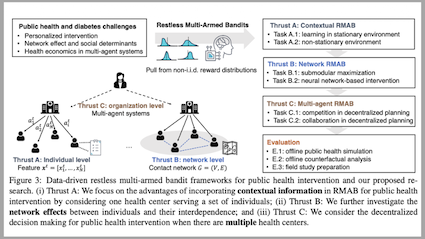
Contextual RMABs use patient histories, biomarkers, demographics, and other data to predict how each individual will respond to an intervention. These models directly provide personalized, data-driven treatments.
By incorporating patient-specific information, contextual RMAB models can help healthcare providers prioritize the most timely interventions. The goal is to improve patient outcomes while making more efficient use of limited healthcare resources.
Next, the group wants to understand social life and community influence in public health. Families and social networks shape how people manage chronic health conditions.
Network RMABs study and account for the role of social factors in health interventions. For example, the models can recognize when one patient responds better to treatment than others through benefits of their social circle.
More broadly, hospitals, clinics, government agencies, and nonprofit organizations often share responsibility for the same population in an area. Sometimes, they even compete for the same medications or funding.
Multi-agent RMABs are the third glass of models aimed at decentralized health systems to make fairer decisions. These tools examine how to coordinate resources and decisions between stakeholders. This in turn leads to policies that encourage cooperation and equitable resource distribution.
“I feel extremely confident in RMABs because we have already seen these frameworks deliver real-world impact,” Wang said.
“Prior success has proven the value of data-driven decision-making under resource constraints, giving us a strong blueprint to effectively address the nuances and complexities of diabetes.”
Wang previously built RMAB models to expand maternal healthcare for women in India. Working in conjunction with the non-profit organization ARMMAN, the models used healthcare information to identify and reach the most vulnerable populations.
By integrating RMAB models into ARMMAN mobile health technology, the partnership has reached over 350,000 mothers. This further led to a 31% improvement in engagement with health information.
Compared to maternal healthcare, diabetes is a more nuanced disease with differing causes, symptoms, and treatments. This requires a team effort spanning institutions and backgrounds.
Dr. Sara Cromer is an endocrinologist at Massachusetts General Hospital (MGH). Experienced diagnosing and treating diabetes, she has studied how social issues and equity influences the disease. MGH will provide much of the patient data to train the RMAB models.
Associate Professor Jian Li studies reinforcement learning at Stony Brook University. His expertise in applying reinforcement learning for resource allocation plays a key part tailoring models for the T2D problem. Wang and Li have previously worked together on RMAB research.
Prakash is an expert in computational epidemiology at Georgia Tech. He has led substantial contributions to the use of AI for networks to predict outbreaks and track disease spread. This experience has led to collaborations with NIH, the Centers for Disease Control and Prevention (CDC), National Science Foundation, and others.
“This project speaks to the interdisciplinary problem-solving we try to achieve in CSE. Despite having different backgrounds, our interest in applying our strengths to real-world healthcare problems unites us together,” Prakash said.
“These problems require experts from all sides. Without computational scientists, we can’t take advantage of available data. We lean on clinical experts to provide the data and expertise needed to guide our methods and make sense of results. Ultimately, these approaches need to be clinically validated if we want to make real-world progress.”