Conference Spotlights Microarchitecture Research and Innovation
Highlighting its growing strength in microarchitecture, Georgia Tech faculty and students recently contributed several research papers and took on leadership roles at a leading conference in the field.
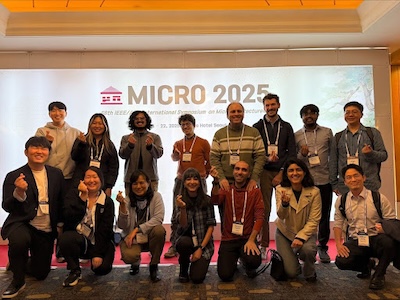
Eight papers accepted by the 58th IEEE/ACM International Symposium on Microarchitecture (MICRO 25) featured Georgia Tech authors. Five of these papers featured faculty and students from the School of Computer Science (SCS). SCS researchers also participated in MICRO 25 through workshops, tutorials, panels, and organizational roles.
“Georgia Tech’s strong presence at MICRO 25 underscores our leadership in advancing computer architecture research and innovation. From groundbreaking GPU simulation techniques to novel memory security solutions, our faculty and students are shaping the future of computing,” said Mostafa Ammar, SCS interim chair.
Swift and Trustworthy Large-Scale GPU Simulation with Fine-Grained Error Modeling and Hierarchical Clustering, co-authored by Professor Hyesoon Kim and Ph.D. student Euijun Chung, proposes a methodology that uses fine-grained kernel-level sampling to accelerate cycle-level simulation of large GPU workloads.
Kim also participated in a panel and helped organize the DoSSA-7 Workshop and Vortex Tutorial/Workshop with SCS Principal Research Scientist Jeffrey Young. She also served as the IEEE TCuARCHChair of the conference, which was held in Seoul, Korea in October 2025.
SCS Associate Professor Alexandros Daglis served as the Tutorials & Workshops Co-Chair of the conference. He also co-authored a paper with Ph.D. student Anish Saxena that offers a new memory allocator design to prevent certain hardware security attacks.
Associate Professor Yingyan (Celine) Lin, along with her Ph.D. students Sixu Li and Zhifan Ye, presented ORCHES: Orchestrated Test-Time-Computation-based LLM Reasoning on Collaborative GPU-PIM HEterogeneous System at the conference. Their paper identifies barriers and solutions for enabling test-time compute (TTC) on edge devices.
Assistant Professor Divya Mahajan, who holds appointments in SCS and the School of Electrical and Computer Engineering (ECE), was a program committee member at MICRO 25 and had two papers at the conference.
Tushar Krishna, ECE associate professor and SCS adjunct faculty, was inducted into the MICRO Hall of Fame. He was also an area chair and a member of the program committee.
Ph.D. student Zishen Wan was selected to present at the conference’s Ph.D. job showcase. He also presented one paper. Krishna and ECE Chair Arijit Raychowdhury advise Wan.
Computer science Ph.D. student Narges Alavisamani won first place in the conference’s student research competition. SCS Professor Moin Qureshi advises Alavisamani.