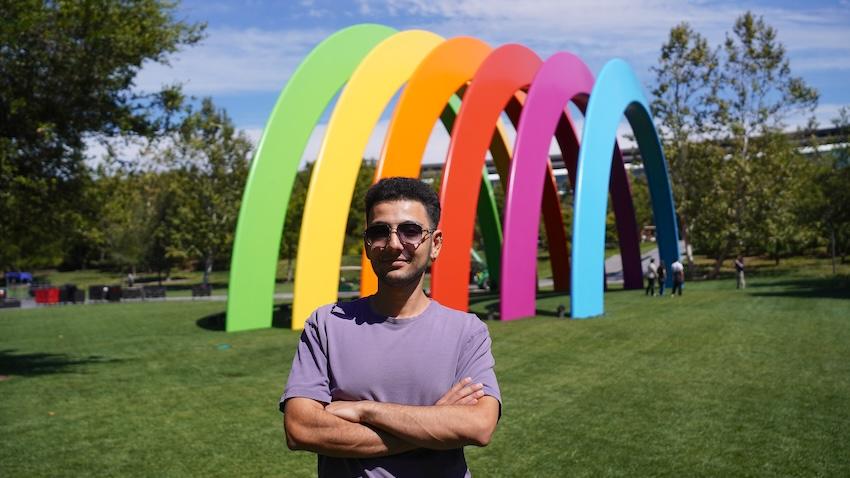
GT Cybersecurity Expert Helping to Chart the Future of AI on the Energy Grid
Artificial intelligence (AI) is becoming increasingly vital to the nation’s power grid. However, AI tools meant to help energy companies manage the grid, plan for future needs, and respond to problems also create new security and safety concerns.
Saman Zonouz, an associate professor in Georgia Tech’s School of Cybersecurity and Privacy and the School of Electrical and Computer Engineering, is helping address those concerns as a member of a planning committee for the National Academies of Sciences, Engineering, and Medicine.
Since May 2026, Zonouz has served on the planning committee for an upcoming public workshop on integrating AI into the electricity system. The workshop is scheduled for Oct. 26 and will convene experts to discuss how to safely and reliably use AI across the power grid.
The workshop will explore how AI is used today, the challenges of integrating AI into existing power systems, and how people and AI can work together. The event will also examine relationships between AI and cybersecurity, data centers, workforce development, and future research.
For Zonouz, cybersecurity and resilience are key parts of the conversation.
“AI is both a shield and a target for the grid,” Zonouz said.
Zonouz leads Georgia Tech’s Cyber-Physical Systems Security Research Laboratory. The lab’s research, much of it funded by the U.S. Department of Energy, investigates how AI can protect power systems from cyberattacks.
One recent initiative combines AI with detailed knowledge about power system operations to detect attacks in near real time. Another project sought to identify security weaknesses in solar inverters and other devices that connect energy sources, such as solar panels, to the power grid.
Regardless of the challenge, Zonouz and his lab work to identify and fix these weaknesses before attackers can exploit them. Despite their best efforts, however, Zonouz said that some AI tools meant to secure a system can create new ways for attackers to target a power grid.
The lab has demonstrated in several studies that AI systems can be tricked by false or manipulated data. Attackers can also target the software and systems that AI depends on. As AI becomes more advanced, some systems may even be able to modify grid operations.
This raises an important question: What happens if an AI system fails or is attacked?
“That is why the right frame is resilience,” Zonouz said.
For Zonouz, the goal is not to create an AI system that can never fail or be attacked. It’s to build a trustworthy power grid that can continue operating safely even if an AI system fails or is compromised.
Zonouz will bring his perspective to the National Academies workshop. In addition to helping organize the event, he will lead a session on cybersecurity and resilience. He will also help summarize the workshop’s key takeaways during the closing session. The workshop will be held virtually in late October.
“Lessons learned from the electricity grid can be applied to other critical infrastructure as AI monitoring and control tools continue to advance and become more common,” he said.