Incoming Professor Envisions World of Humans and Robots Working Together
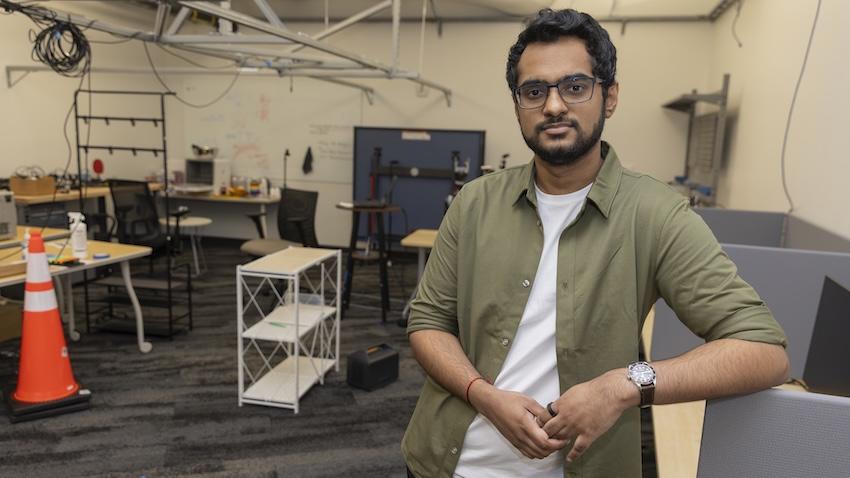
When Siddharth Karamcheti watches robot demonstration videos, he pays attention to how close humans are to the robot.
Karamcheti said there are times when he doesn’t see any humans at all. Those instances reinforce the perception that robots are replacing humans rather than assisting them.
“You have humanoid robots doing things like folding laundry, and you see videos of it on social media,” Karamcheti said. “It bothers me that in all these videos, I see the robot doing these tasks alone without a single person around them. True human-robot collaboration is missing.”
As he joins the Georgia Tech School of Interactive Computing as an assistant professor, Karamcheti seeks to improve human-robot collaboration and maximize output through his research.
Karamcheti comes to Tech after earning his Ph.D. in computer science (CS) from Stanford University. He also holds bachelor’s degrees in CS and literary arts from Brown University.
In addition to human-robot interaction, he has conducted research on fine-tuning vision-language-action (VLA) models.
VLAs are artificial intelligence (AI) systems typically built by fine-tuning vision-language models (VLMs) or large language models (LLMs). They use visual perception, natural language, and physical action to perform tasks.
“I have a high-level vision of what I think robotics should be, but there are many winding paths I like to take along the way as I try to understand why something works the way it does,” Karamcheti said.
Karamcheti said his vision was inspired by the movie Iron Man and by how the main character, Tony Stark, interacts with robots in his lab.
“I don’t want a robot that replaces all the work I’m doing in my life,” he said. “I want a robot that’s embedded in my life like my laptop or smartphone.
“They’re making it possible for me to do more things. I also want to make it so that robots start doing more and learning more when I leave the room.”
Karamcheti said the School of IC is a “dream” job for him because of its renowned faculty in human-robot interaction. It’s the ideal place to keep humans at the center of his research.
“We must design models around interaction and the idea that there’s going to be a person in the room. Robots don’t need to be perfect at any one thing. They just need to be able to ask for help when it’s needed and learn from those teaching interactions.”
Karamecheti said many robotics researchers are pursuing robots that are as close to perfect as possible so they can operate without human oversight. However, the amount of money and data needed to get there is substantial.
“I think you see diminishing returns with scale. If a robot performs tasks correctly 90% of the time, the data required to go from 90% to 95% is much less than that required to go from 95% to 99%. Many robotics companies and labs are investing to reach a 99% success rate,” he said.
Karamcheti added that the pursuit of perfection shouldn’t prevent a robot from being deployed. They could be deployed at 95% and increase their success rate by working with and learning from humans.
“Once I have a robot that’s 95% capable, I understand that 5% of failures will occur for a specific task. If I know a human is always going to be near the robot, I can design a system that sequences tasks and anticipates human intervention.”
Karamcheti is recruiting students to join his lab who bring new perspectives to robotics.
“I’m looking for students who aren’t afraid to challenge common assumptions and who enjoy hacking and building,” he said. “I want to work with students who have strong opinions about how robotics should look.”