Internship Highlights Industry’s Role in Advancing Safe, Trustworthy AI
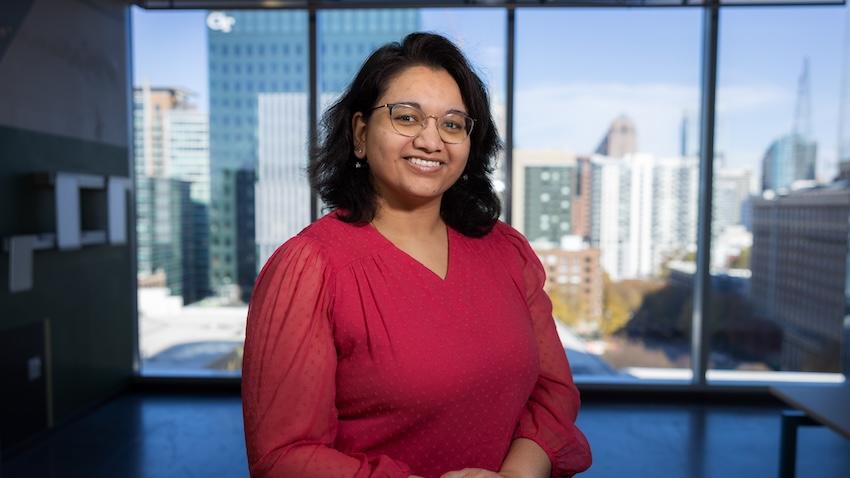
Academic researchers often focus on advancing fundamental knowledge, while industry puts that knowledge into practice. This summer, Ph.D. student Mansi Phute experienced both sides of the process during an internship focused on making artificial intelligence (AI) safe, trustworthy, and reliable.
Upon returning to Georgia Tech, Phute reflected on her summer internship and what it taught her about the evolving relationship between research and industry.
Student: Mansi Phute
Research Interests: Machine learning (ML) robustness and artificial intelligence (AI) safety
Degree Program: Ph.D. in Computer Science
Faculty Advisor: School of CSE Professor and Associate Chair Polo Chau
2026 Internship: International Business Machines (IBM), San Jose, California
What about IBM interested you in applying for and accepting an internship there?
IBM is often at the forefront of AI safety, my field of interest, and has a culture that encourages exploratory and fundamental research. I felt this would give me a closer look at cutting-edge industry approaches without compromising on my research interests or my progress toward my thesis.
How well did your coursework and experience at Georgia Tech prepare you for your IBM internship?
My experience at Georgia Tech was very helpful in preparing me for IBM. My coursework and other academic experiences certainly transferred over, but I believe that the wide range of people I met during those courses and what I learned from them helped me connect and relate strongly with people at IBM. Being conversant in different fields of research really helped me interact better with IBM coworkers and feel comfortable in a new environment.
What did you work on while interning at IBM?
I worked on IBM’s AI Foundations team, focusing on the security of multimodal agent communication during my internship. This is an important problem as we see an increase in agents applied in many use cases. It was also closely aligned with my research interests of AI safety.
Do you have a favorite memory or remarkable achievement from your internship?
One of my favorite moments was presenting my work to a broad, cross-team audience of technical and non-technical members. Afterward, my manager told me I was good at explaining my research to people with varying levels of familiarity with the domain. This feedback meant a lot to me because communicating clearly across different audiences is a skill I've deliberately worked to improve. So, hearing that the effort was paying off was very rewarding.
Overall, how helpful was this internship toward your studies at Georgia Tech and your career as an aspiring researcher?
This internship was very valuable for my development as an aspiring researcher. I worked alongside accomplished people in the AI safety field on projects that aligned closely with my research interests. I also saw how those same projects connect to a company's broader business priorities, a perspective that isn’t easily available in academic settings. I shared many fruitful discussions with people working in safety, policy, and alignment, which gave me a much clearer sense of how industry approaches these issues compared to the more academic-oriented framing I am used to.
Based on what you learned during your internship, how important is private industry in progressing research and scientific discovery?
Working in private industry was a fascinating experience. I come away believing that industry plays an important role in advancing research, especially in AI, where companies have access to computing resources that are less prohibitive than in academic environments. I also think that because private industry has a strong hand in implementing and deploying research, understanding industry priorities can help us frame and design our research in ways that complement industry applications. This ensures research has a bigger impact, particularly in the domain of ML safety and reliability.