New AI Models Could Create More Accurate Visualizations of Classical Architecture
The release of the 2026 film adaptation of The Odyssey sparked intense debate among historians and classical scholars about its accuracy in depicting ancient Greece.
However, new artificial intelligence (AI) models developed at Georgia Tech may soon weigh in on the debate, providing a richer, more accurate understanding of what classical structures looked like than ever before.
The new AI and machine learning models developed by GT researchers will provide archaeologists and classical architecture experts with better analytical tools for studying temples, theaters, homes, and other structures from ancient Greece.
These models could enable researchers to draw conclusions and make new discoveries in a fraction of the time required to identify and analyze archaeological data using traditional statistical methods.
Kartik Goyal and Myrsini Mamoli received a $225,000 grant from the National Endowment of the Humanities earlier this year to support interdisciplinary collaboration, including the development of the models.
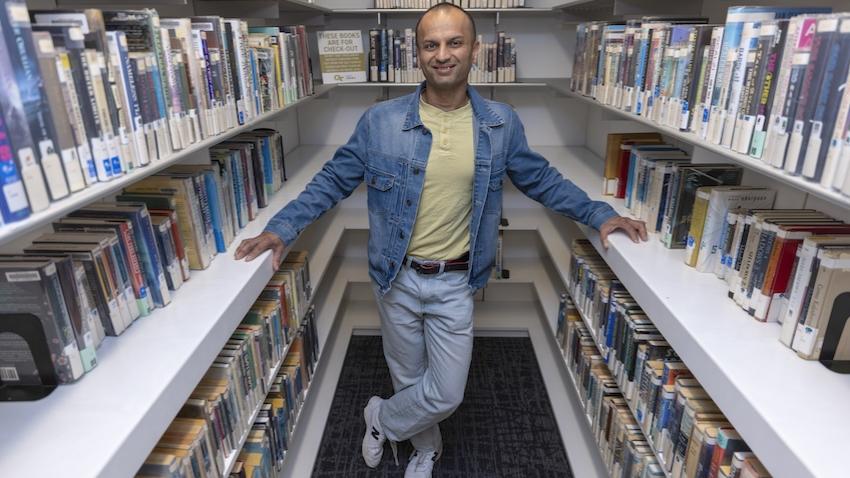
Goyal is an assistant professor in Tech’s School of Interactive Computing. He researches how natural language processing can benefit humanities scholars, including analyzing historical texts to make new discoveries.
Mamoli, a native of Greece, is an architectural historian and joint lecturer in the School of Architecture and School of History and Sociology. She conducted early research on how computational methods can help reconstruct historical architectural remains while earning her Ph.D. in architecture from Tech.
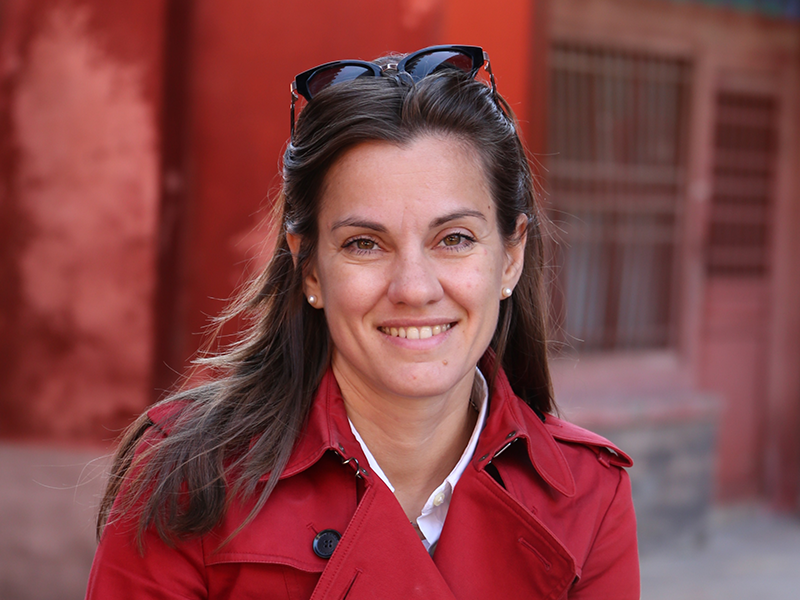
Mamoli is one of hundreds of researchers who spend their summers each year studying archaeological sites and monuments in Greece or Italy. She is among a select few working at the Ancient Agora in Athens.
“The Agora is where the political buildings of Athens emerged, and democracy was born, so it’s one of the most important sites in the classical world,” said Mamoli.
“Having been excavated by the American School of Classical Studies in Athens for almost 100 years, it’s the most well-funded, systematically explored, and most digitally well-documented site.”
More than 180,000 artifacts have been uncovered at the Ancient Agora.
The physical structures that have survived for thousands of years, along with recorded data and references in ancient texts, are the primary sources scholars rely on to determine what buildings might have looked like in antiquity.
Mamoli said identifying and studying all comparable structures and formulating hypotheses about them takes years. Every discovery made at the Agora since 1933 has a digitized record, leaving a massive amount of data to sort through.
AI can comb through it in a matter of moments and help researchers fill the gaps.
“Anything I want to look at, I can access it online, but the process of going through and connecting the dots and identifying certain design principles like proportions and material is tedious. Imagine if we could feed this data into an AI model that would automatically discover the connections.”
Mamoli said architecture has its own “language” that can be analyzed as a shape grammar. This visual, rule-based mathematical concept is used to generate designs in that language. Each architectural style has its own shape grammar.
Mamoli’s work as a Ph.D. student involved manually computing this information to generate 2D visualizations. Now, she hopes Goyal’s models will enable the instant conversion of data into more subjective and accurate visualizations.
“You encode these design principles and then apply them recursively, and you come up with various possible reconstructions,” she said. “Making these rules is time-consuming, so we hope with AI, a whole fresh approach can happen where AI can discover the rules by looking at the data at scale.”
Goyal has already used similar methods to analyze early modern English printed books and identify their printing origins. When Mamoli approached him about collaborating with her, he believed the same process could be applied to reconstructing classical buildings.
“Ancient texts and historical architecture records can help us fill in the blanks,” Goyal said.
“These systems can automatically infer patterns from the fragmentary plans described in various texts. To automatically generate a proposed reconstruction, we are deploying machine learning techniques. They make the model not just think about producing tokens or pixels, but also about the aesthetic and geometric features.”
Goyal said he’s aware some humanities scholars have expressed concern that AI could compromise scholarly integrity. Large-language models, for example, can struggle to account for cultural nuances and often inject biased hallucinations into their output.
“This is reflected in many problems in the humanities that I’m working on — the need for AI systems to be more transparent and more easily modifiable,” he said. “If we run these models blindly, we risk incorporating undetected bias.”
Mamoli said it’s important to limit the scope of AI and think of it as a tool.
“I strongly believe that AI should not replace the human brain,” she said. “I don’t see it replacing the scholarly work that is being done. I see it as assisting it.
For archaeologists, it may be necessary.
With so many sites being excavated, it could be the best way to keep track of hundreds of thousands of artifacts and use them to gain a clearer historical understanding.
“Right now, I am working in the Section Iota in the Agora of Athens,” said Mamoli.
“This is a disturbed site with artifacts from all over the Agora because people have moved them for secondary uses. What if an AI model could instantly create a map to trace that movement and show exactly where these fragments came from?”