Ph.D. Student Gets the Assist as Bike Robot Performs First Front Flip
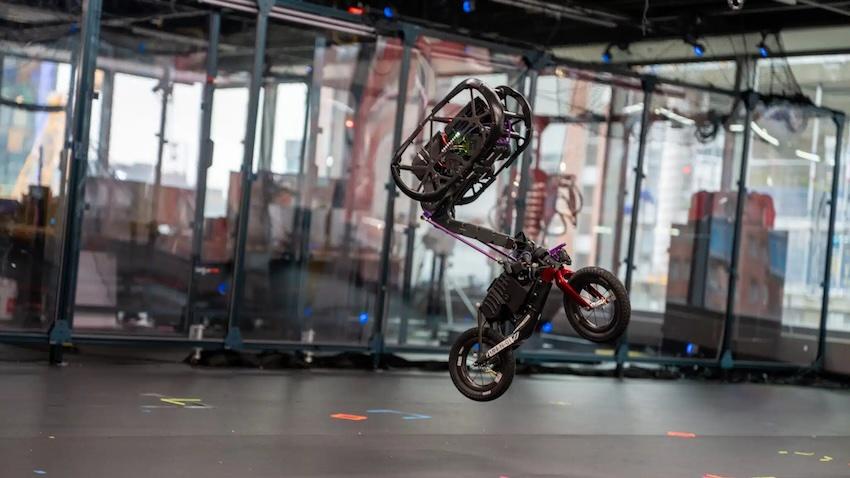
A bicycle robot from the Robotics and AI Institute (RAI) in Cambridge, Mass., has become the first to perform an unassisted acrobatic front flip.
RAI calls the bicycle robot an ultra-mobility vehicle (UMV). It can reach a height of 3 feet and can jump from the floor onto a platform.
The contributions of a Georgia Tech Ph.D. student helped make these feats possible through a robot control policy he developed.
Jeonghwan Kim, who is pursuing a Ph.D. in robotics under the advisement of Associate Professor Sehoon Ha, spent two semesters interning at RAI. His task was to design a policy to teach the UMV to land after a flip.
The result was iterative motion imitation (IMI), a novel method that imitates flip trajectories generated from prior examples. Kim said the robot bases its flip on a demonstration, and human engineers reconstruct and refine the flip path through simulation to fill in the gaps.
“To guide the robot to flip, we started with an imperfect trajectory generated by a motor-based controller and then ran simulations,” Kim said. “It’s an unstable trajectory, but we use it as a guide to train a single policy that can track it as it lands and tries to balance itself.”
Sticking the Landing
Kim interned under the supervision of Shamel Fahmi, a research scientist at the RAI Institute. RAI has been developing the UMV for nearly three years.
“We wanted to work on a different robot morphology that wasn’t legs or legs with wheels,” Fahmi said. “That’s when we thought of working with bikes.
“We want to merge the athleticism of (Boston Dynamics’) Atlas with the mobility of a bike. We wanted a robot that can go anywhere, do parkour, and acrobatics.”
Fahmi said that before Kim arrived, the research team had trouble getting the UMV to land consistently without breaking or falling.
The UMV has two joints — an upper and a lower. The upper joint contains the motors and pulls the lower joint along as it propels into the air. The problem is getting the lighter lower joint to absorb the impact of landing without being crushed by the heavier upper joint.
“That’s what brings reinforcement learning into the equation,” Fahmi said. “We teach the robot to minimize its impact on the ground to land gracefully.”
Fahmi said that Kim proved the imitation examples the robot learns from don’t have to be perfect. The process takes some time, but all it needs is a rough idea to get started.
“You can have an imperfect sketch and then constantly refine it,” Fahmi said. “The first time, it’s not going to go well.
“We don’t care about torque or power limits as long as it does the motion. Then we’ll have a slightly better reference, repeat it, and imitate it again. In every iteration, we can add more parameters.”
Up Against the Clock
Kim said he felt the pressure of time constraints during his two semesters with RAI as he worked to achieve consistent, successful landings. Even though he had multiple UMVs to experiment with, they broke down dozens of times. Each time one broke, a hardware team at RAI had to repair it.
“There was a lot of pressure to not only get this working before my internship ended, but also knowing there are costs behind every failed attempt, and every time the robot breaks, it takes time to repair it,” Kim said.
“It took almost five months for it to land without breaking. Then we needed two more months for it to stay balanced after the landing. It requires a lot of engineering effort to achieve a robust control policy for a safe flip.”
By the time Kim left RAI, the IMI policy had achieved consistent, seamless landings.
“The jump right now is what we call the visitor demo,” Fahmi said. “If there are guests coming over to see it, we want to show them something that is extremely impressive, but also, more importantly, extremely reliable. It never fails.
“It was only possible because of the huge effort we put into designing, maintaining, and continuously improving the robot.”
Kim authored a paper on his framework and will present it at this week’s International Conference on Robotics and Automation (ICRA) in Vienna.
For more information about the UMV project, please visit the RAI blog or watch their video on YouTube.