SCI Faculty Brings Human-Centered AI Expertise to International Fulbright Summit
A School of Computing Instruction (SCI) faculty member recently shared his expertise in computing education with an international audience.
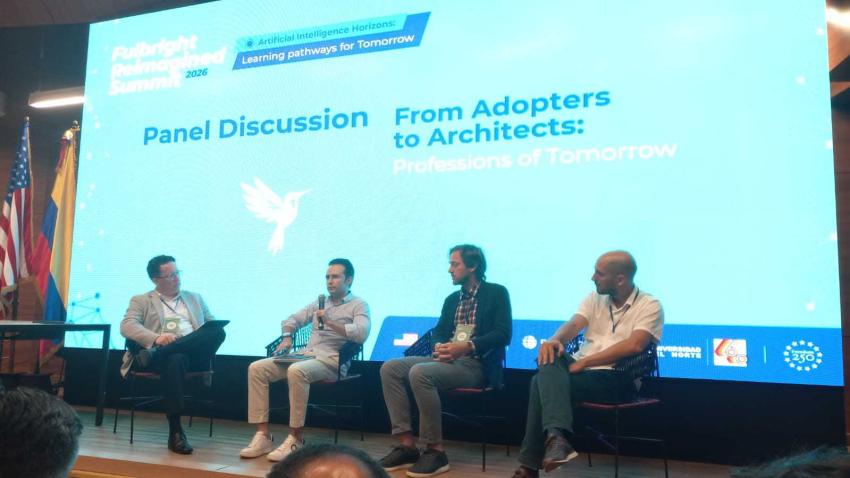
SCI Instructor Pedro Guillermo Feijóo-García was selected by Fulbright Colombia to moderate the closing panel of the Fulbright Reimagined Summit 2026: AI Horizons: Learning Pathways for Tomorrow.

Held last month at Universidad del Norte in Barranquilla, Colombia, the summit convened scholars, educators, policymakers, and industry leaders to examine how artificial intelligence (AI) is transforming education, work, governance, and society.
Fulbright Colombia invited Feijóo-García to moderate the closing discussion, From Adopters to Architects: Professions of Tomorrow, in recognition of his research on human-AI interaction and the hidden curriculum in engineering and computer science education.
"As a Fulbright alumnus, being invited to contribute to such an important event was an honor and a privilege," Feijóo-García said. "Beyond the personal recognition, I viewed this opportunity as a meaningful platform to facilitate conversations around the future of education, technology, and workforce development."
From Computing Education to AI Futures
At Georgia Tech, Feijóo-García directs the People-Agents Research for Computing Education (PARCE) Laboratory. His research examines the intersection of computing education, STEM learning, and AI, focusing on student preparedness, professional development, and the hidden curriculum- which he explains as the implicit skills and expectations that shape students' academic and career success.
Feijóo-García says his perspective is shaped by years of work in computing education. During his master's studies in systems and computing engineering at Universidad de los Andes in Colombia, he explored ways to expand access to computing education through interactive programming environments. He went on to earn his Ph.D. in human-centered computing from the University of Florida, where he focused his research on computing education and human-centered AI.
"AI is transforming how we learn, work, communicate, make decisions, and interact with one another," Feijóo-García said. "As educators, we need to prepare students not only with technical competencies, but also with critical thinking, ethical reasoning, collaboration, and the ability to adapt."
Preparing Students for the Professions of Tomorrow
Rather than viewing AI as a challenge for higher education, Feijóo-García sees it as an opportunity for universities to rethink how they prepare students for an evolving workforce. He believes educators should help students develop the judgment to know when AI can enhance their work and when independent reasoning and human expertise are essential.
"The conversation should not revolve around whether AI belongs in education, but rather how we integrate it responsibly and intentionally," Feijóo-García said.
He also hopes students begin to think of AI not only as artificial intelligence, but as augmented intelligence. "The goal should not be to replace human thinking, but to enhance it," he said.
Feijóo-García emphasized that AI should augment human capabilities rather than replace human judgment. Preparing students for an AI-driven workforce requires helping them understand when AI can support their work and when human reasoning, creativity, and expertise are essential.
Strengthening U.S.–Colombia Collaboration
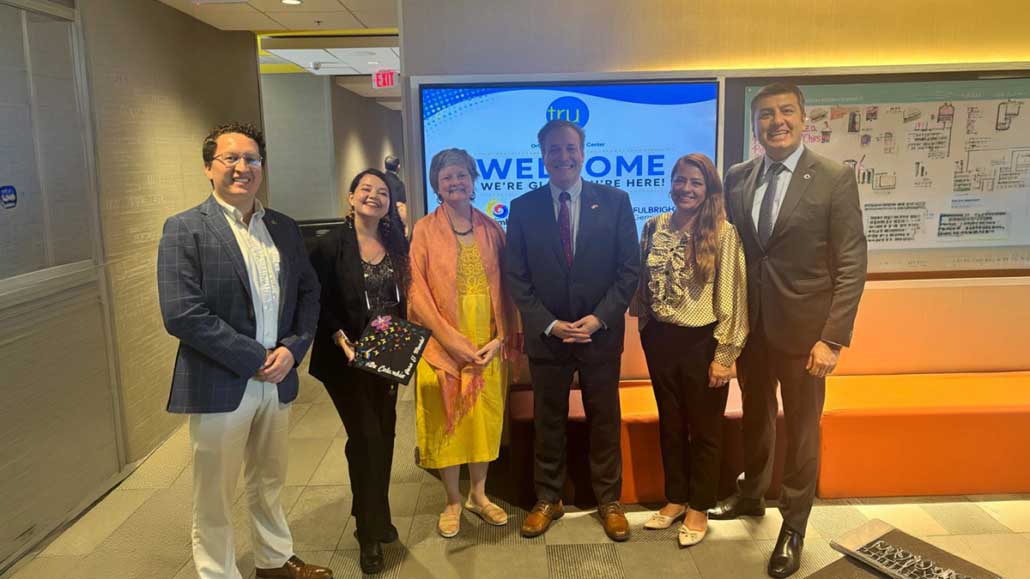
The summit reinforced the value of collaboration among scholars, educators, policymakers, and industry leaders in advancing research and education. Earlier this year, Feijóo-García participated in another Fulbright Colombia event focused on strengthening scientific collaboration between Colombia and the United States.
The Fulbright Program, which operates in more than 160 countries worldwide, is the United States government’s flagship international academic exchange program to support peaceful relations between the people of the U.S. and the people of other countries. Fulbright Colombia, the binational commission for educational exchange between the U.S. and Colombia, has supported academic and scientific collaboration between the two countries since 1957.
Feijóo-García’s academic journey reflects the impact of these collaborations. The Fulbright Program supported his doctoral studies in the United States, and he continues to build connections between Colombia and the U.S. through his work at Georgia Tech.
"Scientific diplomacy is built on people," Feijóo-García said. "Events like the Fulbright Reimagined Summit provide the environment where trust is established, ideas are exchanged, and collaborations begin."