Undergrads Earn National Recognition for Computing Research
Two Georgia Tech undergraduates are being recognized for their contributions to computing research.
Ryan Punamiya (CS 2025) and Summer Abramson, a third-year computational media student, have been honored by the Computing Research Association (CRA) through its 2025–2026 Outstanding Undergraduate Researcher Award (URA) program.
Punamiya was named a runner-up for the prestigious award, while Abramson received an honorable mention among hundreds of applicants from universities across North America.
The CRA Outstanding Undergraduate Researcher Award program recognized eight awardees in 2026, along with eight runners-up, nine finalists, and over 200 honorable mentions from thousands of applications.
Advancing Robotics Research
Punamiya knew early on that he didn’t want to wait until starting his Ph.D. to do meaningful and impactful robotics research.
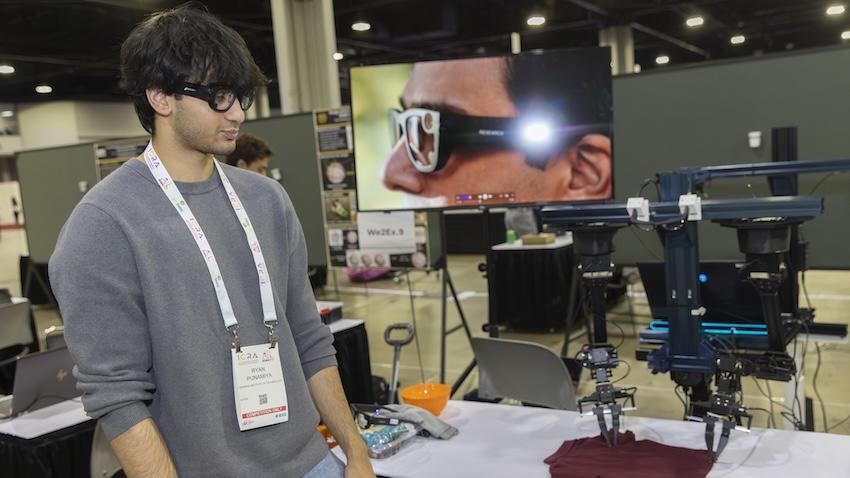
Punamiya joined the Robot Learning and Reasoning Lab (RL2) directed by Assistant Professor Danfei Xu. While there, he contributed to the lab’s Meta-sponsored EgoMimic project, which trains robots to perform human tasks using recordings captured by Meta’s Project Aria research glasses.
Punamiya is also the first author of a paper accepted to the 2025 Conference on Neural Information Processing Systems (NeurIPS), one of the world’s most prestigious artificial intelligence (AI) and machine learning conferences.
“Ryan is the strongest undergraduate I've worked with,” Xu said, “including students who went on to Stanford, Berkeley, and leadership roles in major tech companies. He’s already operating at the level of a strong third-year Ph.D. student.”
Punamiya said it was a challenge to balance his undergraduate coursework with his research in Xu’s lab.
“You get out how much you put in,” he said. “I built my class schedule to give myself as much time to do research as possible. It also boils down to having the right research mentors.
“(Xu) never saw me as an undergrad who’s just there to do grunt work. I was fortunate he saw my curiosity and cultivated me as a researcher. That’s really how you get more undergrads motivated to research — giving them the chance to be independent and explore ideas of their own.”
Punamiya said his work in Xu’s lab has already helped him identify the research areas he wants to focus on as he considers his next steps. He will continue developing generalized training models for robots using human data so they can perform tasks instantly upon deployment.
"The amount of data needed to train a robot is difficult to obtain even for top industry companies," he said. "We have embodied robot data available in billions of humans. With the advent of extended reality devices, we can get a scalable source of diverse interactions within environments."
Punamiya graduated in December and recently started an internship at Nvidia. He mentioned he has been accepted into several Ph.D. programs, including Georgia Tech, and he is choosing where to continue his research.
“It’s the first time my research has been acknowledged externally by the robotics community,” he said. “It’s good to know the problem I’m working on is important, and that motivates me. Robotics is an exciting field. We are doing things now that two years ago were difficult to do.”
Researching Inclusion in Computing Education
Abramson conducts research in the People-Agents Research for Computing Education (PARCE) Laboratory under the mentorship of Pedro Guillermo Feijóo-García, a faculty member in the School of Computing Instruction. He and the Associate Dean for Undergraduate Education, Olufisayo Omojokun, nominated her for the award.
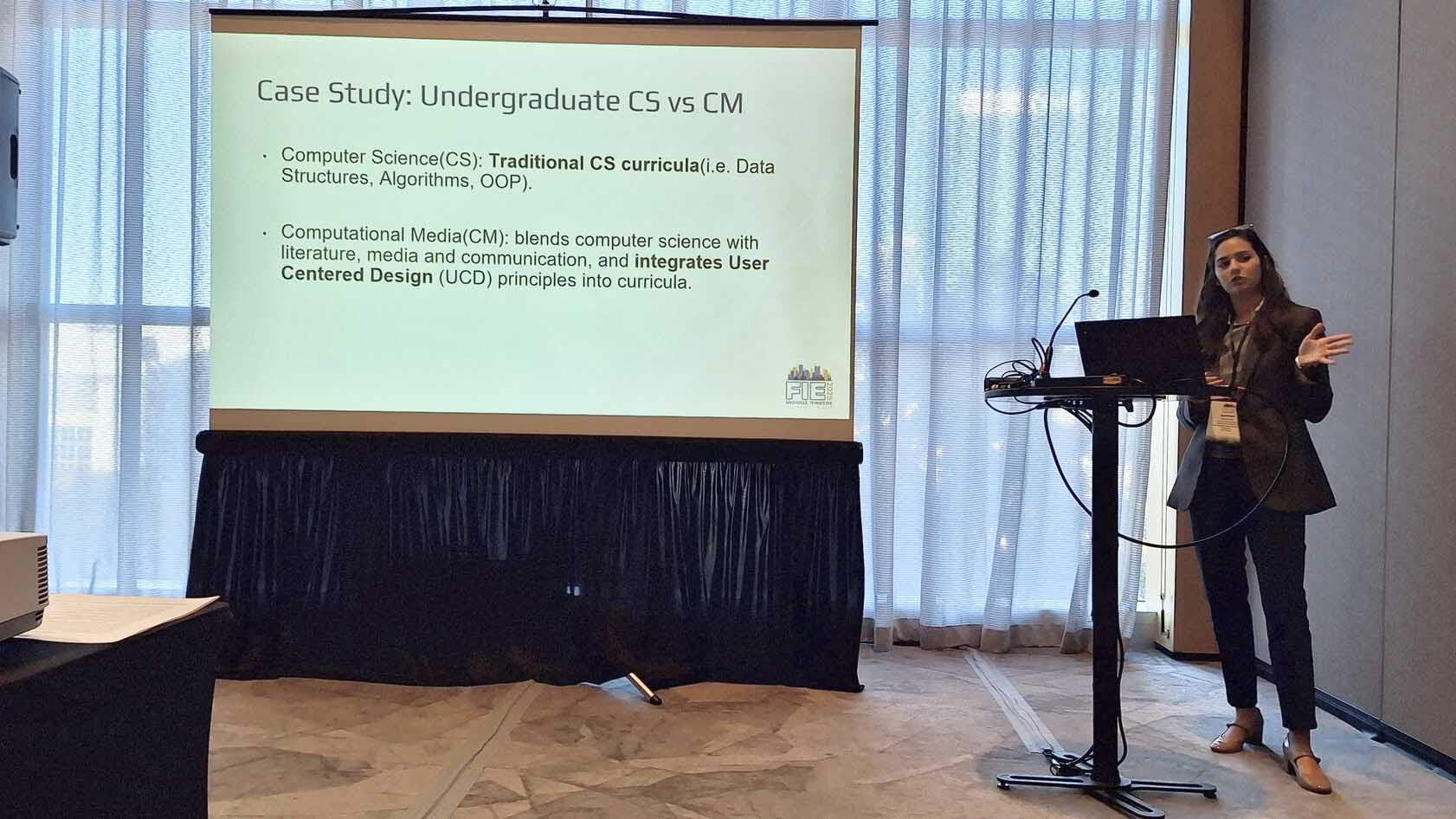
Her work focuses on the intersection of computing education and human-AI interaction, where she’s been exploring ways to create more equitable technology.
“This is such a huge milestone, and I couldn't be prouder of Summer,” Feijóo-García said. “Mentoring her for almost two years has been an amazing experience.”
Abramson has received the Georgia Tech President’s Undergraduate Research Award (PURA) twice, which supports her research exploring how user-centered design curricula can help address attrition among women in computing.
“I’ve had the amazing opportunity to pursue research at the intersection of student identity, community belonging, and how we can build tools that support our diverse student population,” Abramson said.
“Dr. Pedro and I have a goal to build community through a human-first approach, and I could not be more grateful for his support and guidance in my own journey. The CRA highlights the best of what the computing discipline has to offer, and I am incredibly honored for our work to be recognized.”
Abramson will spend the summer researching how user-centered design curricula can help promote confidence, belonging, and retention for women in computing.
Nominees for the PURA program were recognized for contributing to multiple research projects, authoring or coauthoring papers, presenting at conferences, developing widely used software artifacts, and supporting their communities as teaching assistants, tutors, and mentors.
School of Computing Instruction Communications Officer Emily Smith contributed to this story.
Main Photo: Ryan Punamiya works with a robot during the 2025 International Conference on Robotics and Automation in Atlanta. Photo by Terence Rushin/College of Computing.