Department of Energy Award to Power Nuclear Research with Machine Learning
The future of clean energy depends on algorithms as much as it does atoms.
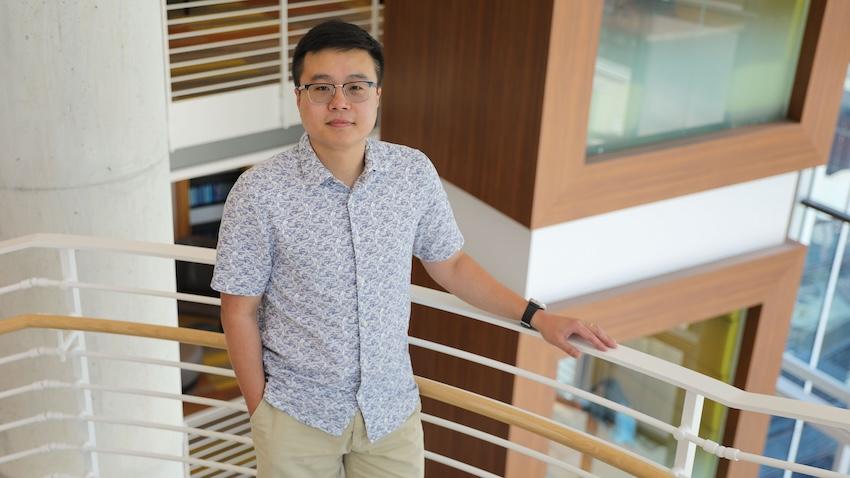
Georgia Tech’s Qi Tang is building machine learning (ML) models to accelerate nuclear fusion research, making it more affordable and more accurate. Backed by a grant from the U.S. Department of Energy (DOE), Tang’s work brings clean, sustainable energy closer to reality.
Tang has received an Early Career Research Program (ECRP) award from the DOE Office of Science. The grant supports Tang with $875,000 disbursed over five years to craft ML and data processing tools that help scientists analyze massive datasets from nuclear experiments and simulations.
Tang is the first faculty member from Georgia Tech’s College of Computing and School of Computational Science and Engineering (CSE) to receive the ECRP. He is the seventh Georgia Tech researcher to earn the award and the only GT awardee among this year’s 99 recipients.
More than a milestone, the award reflects a shift in how nuclear research is done. Today, progress depends on computing and data science as much as on physics and engineering.
“I am honored and excited to receive the ECRP award through DOE’s Advanced Scientific Computing Research program, an organization I care about deeply,” said Tang, an assistant professor in the School of CSE.
“I am grateful to my former colleagues at Los Alamos National Laboratory and collaborators at other national laboratories, including Lawrence Livermore, Sandia, and Argonne. I am also thankful for my Ph.D. students at Georgia Tech, whose dedication and creativity make this award possible.”
A problem in nuclear research is that fusion simulations are challenging to understand and use. These simulations generate enormous datasets that are too large to store, move, and analyze efficiently.
In his ECRP proposal to DOE, Tang introduced new ML methods to improve the analysis and storage of particle data.
Tang’s approach balances shrinking data so it is easier to store and transfer while preserving the most important scientific features. His multiscale ML models are informed by physics, so the reduced data still reflects how fusion systems really behave.
With Tang’s research, scientists can run larger, more realistic fusion models and analyze results more quickly. This accelerates progress toward practical fusion energy.
“In contrast to generic black-box-type compression tools, we aim at preserving the intrinsic structures of the particle dataset during the data reduction processes,” Tang said.
“Taking this approach, we can meet our goal of achieving high-fidelity preservation of critical physics with minimum loss of information.”
Computing is essential in modern research because of the amount of data produced and captured from experiments and simulations. In the era of exascale supercomputers, data movement is a greater bottleneck than actual computation.
DOE operates three of the world’s four exascale supercomputers. These machines can calculate one quintillion (a billion billion) operations per second.
The exascale era began in 2022 with the launch of Frontier at Oak Ridge National Laboratory. Aurora followed in 2023 at Argonne National Laboratory. El Capitan arrived in 2024 at Lawrence Livermore National Laboratory.
With Tang’s data reduction approaches, all of DOE’s supercomputers spend more time on science and less time waiting for data transfers.
“Qi’s work in computational plasma physics and nuclear fusion modeling has been groundbreaking,” said Haesun Park, Regents’ Professor and Chair of the School of CSE.
“We are proud of Qi and what this award means for him, Georgia Tech, and the Department of Energy toward leveraging computation to solve challenges in science and engineering, such as sustainable energy."
Previous Georgia Tech recipients of DOE Early Career Research Program awards include:
Itamar Kimchi, assistant professor, School of Physics
Sourabh Saha, assistant professor, George W. Woodruff School of Mechanical Engineering
Wenjing Lao, associate professor, School of Mathematics
Ryan Lively, Thomas C. DeLoach Professor, School of Chemical & Biomolecular Engineering
Josh Kacher, associate professor, School of Materials Science and Engineering
Devesh Ranjan, Eugene C. Gwaltney Jr. School Chair and professor, Woodruff School of Mechanical Engineering