School of IC Reels in Best Paper Recognition at CHI 2016
AI is shaping human social behavior, and overreliance on it could erode users’ skills.
This is one of several subjects for which researchers from Georgia Tech’s School of Interactive Computing earned awards at the 2026 Conference on Human Factors in Computing Systems (CHI).
Five papers with Georgia Tech researchers as lead authors received best paper and honorable mention recognition at this year’s conference happening this week in Barcelona.
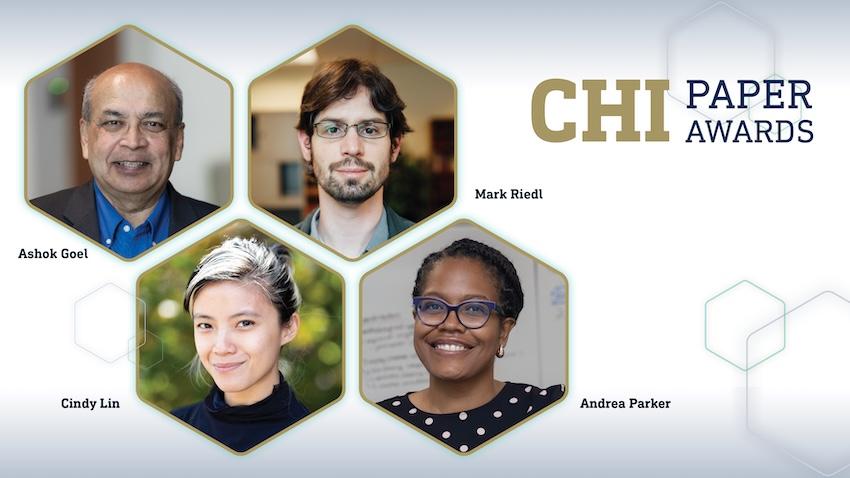
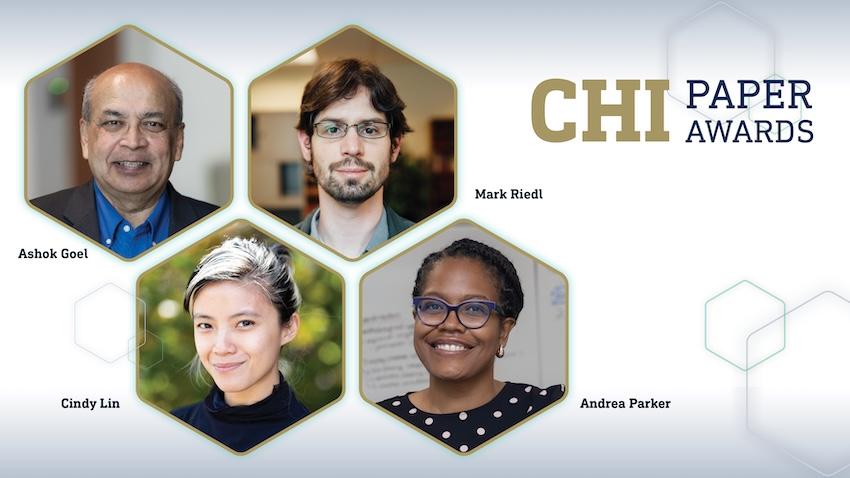
Assistant Professor Cindy Lin and master’s student Tanmaie Kailash won the best paper award for their paper, Localized Imaginaries, Global Assets: Sociotechnical Imaginaries and the Assetization of Data Centers in Singapore. The paper examines the paradoxical rise of data centers in tropical, land-scarce regions.
In cold climates, data centers operate more efficiently, consume less energy, and minimize their carbon footprint.
Despite year-round hot, humid weather and one of the world’s highest population densities, Singapore has over 60 data centers.
“Singapore has become a data center hub in Southeast Asia,” said Lin, who is a native of the city-state. “The common perception of a data center is a building surrounded by a vast amount of land. The truth is they take many different forms.”
Kailash said one reason data centers are sprouting in places like Singapore is that companies and governments see them as investment assets.
“They are not just buildings,” Kailash said. “They’re being positioned as something that will bring future investment into Singapore. They will bring money into the economy. But there’s also a social cost to it that this narrative obscures.”
Best Paper — Promise or Peril? Exploring Black Adults Perspectives on the Use of Artificial Intelligence in Health Contexts
Associate Professor Andrea Parker collaborated with colleagues at Google to author a paper examining the perspectives of African Americans on the use of artificial intelligence in healthcare.
Parker and her co-authors argue that the Black population experiences widespread health inequities, yet has little input on how AI is used in healthcare. Engaging the population in the design of health AI tools is essential to reducing those inequities.
For their study, they conducted focus groups with 18 Black adults to articulate previously unreported perspectives that will inform future work on AI in healthcare.
They found that participants were optimistic about the future of health AI, but they also had concerns rooted in their experience with healthcare system failures.
“AI is rapidly integrating into healthcare,” Parker said. “While the technology holds much promise, we are already seeing how it is perpetuating longstanding disparities in health.
“We seek to use AI perspectives of communities that have experienced these disparities to provide direction for future work that will strengthen these communities’ well-being.”
Honorable Mention — Futuring Social Assemblages: How Enmeshing AIs into Social Life Challenges the Individual and the Interpersonal
Student authors Lingqing Wang, Chidimma Anyi, Yingting Gao, and Professor Ashok Goel received an honorable mention for their work on how AI integrates into human social life and influences social behavior.
The researchers conducted a multiphase study with 24 members of Georgia Tech’s Online Master of Science in Computer Science (OMSCS) program.
“We thought it was a good starting point to use an online program for this study because people in online programs face social isolation,” Wang said. “They watch videos and do the homework without any interaction with others. We wanted to know how AI can be used to keep them socially engaged through these programs.”
The researchers found that many are concerned that AI’s integration into human social life will dilute the authenticity of personal relationships. As AI fulfills more of the human need for emotional connections, users are more likely to socially detach.
Wang said it’s worsening the problem that AI technologies are designed to solve.
“We form our identities through social interaction,” Wang said. “If you’re interacting with AI more than humans, then AI is shaping your identity.”
Honorable Mention — From Future of Work to Future of Workers: Addressing Asymptomatic AI Harms for Dignified Human-AI Interaction
Upol Ehsan (Ph.D. CS 2024), an assistant professor at Northeastern University, authored a paper based on a study he began at Georgia Tech. He collaborated with Professor Mark Riedl on the paper, which shows how overusing AI can erode skills.
“When we no longer perform a skill because AI is doing it for us, our muscle memory of that skill begins to atrophy,” Riedl said.
Ehsan, Riedl, and their collaborators studied whether radiation oncologists’ expertise weakens after implementing AI systems to formulate cancer treatment plans.
One oncologist said that while AI led to faster treatment plans and better metrics, he felt his intuition was rusting. In their paper, Ehsan and Riedl argue that the oncologist is not an anomaly.
Honorable Mention — Situated Imaginaries: Designing AI Futures with Computer Science Teaching Assistants
Ph.D. student Grace Barkhuff is putting a spotlight on a neglected demographic of educators and how they use AI tools.
Barkhuff conducted a series of design workshops with 131 teaching assistants at two U.S. universities to learn how they use AI and how tools can be improved to meet their needs. The study revealed tensions arising from the current use of AI, opportunities for improvement, and the handling of ethical dilemmas.
For comprehensive coverage of Georgia Tech at CHI and a full list of best papers across the Institute, visit https://sites.gatech.edu/research/chi-2026/