

Dean's Dispatch: October 29, 2026
Dear GT Computing Community,
October has been an exceptionally busy and exciting month, with a wide range of events and accomplishments across our College. As a result, this dispatch is longer than usual—there is a lot to celebrate and share, so please take some time to soak it all in!
I also want to offer a special thank you to everyone who completed the Gallup Q12 Employee Engagement Survey by last Friday’s deadline. Thanks to your participation, our final response rate reached 64%, close to our 66% participation rate in Fall 2024. I look forward to reviewing the results and, more importantly, using what we learn to continue strengthening our workplace culture across the College.
Recent Events
First, many thanks to everyone who joined our Faculty and Staff Strategic Planning Sessions on October 15 and 16. As you can see in the photos, we had an amazing turnout on both days.
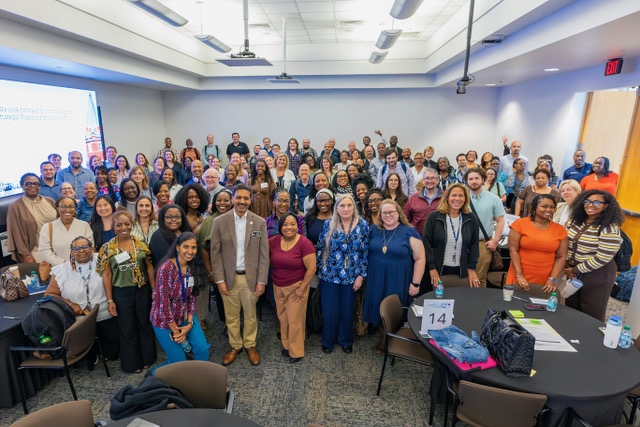
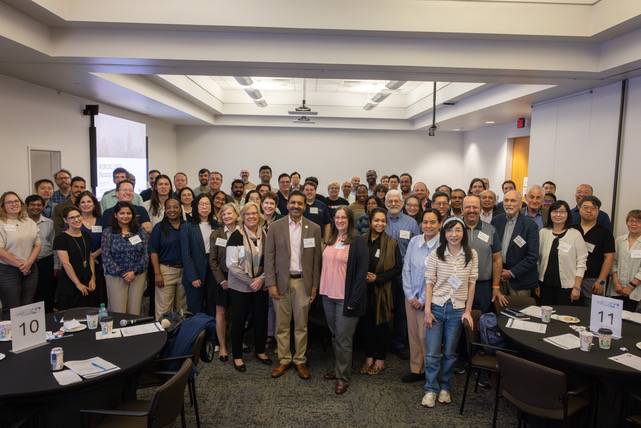
Your input is incredibly valuable as we embark on this process, and we will seek it again at multiple points as our strategic planning effort unfolds over the coming months.
Next, we had a wonderful turnout for the celebration of Rich DeMillo on October 21. Thank you to everyone who shared memories and reflections from different stages of Rich’s remarkable career. Rich’s long association with Georgia Tech began as a Ph.D. student and continued as a faculty member and as our second Dean, during which he played a key role in launching our first three schools and helping reinvent undergraduate education through the Threads curriculum.
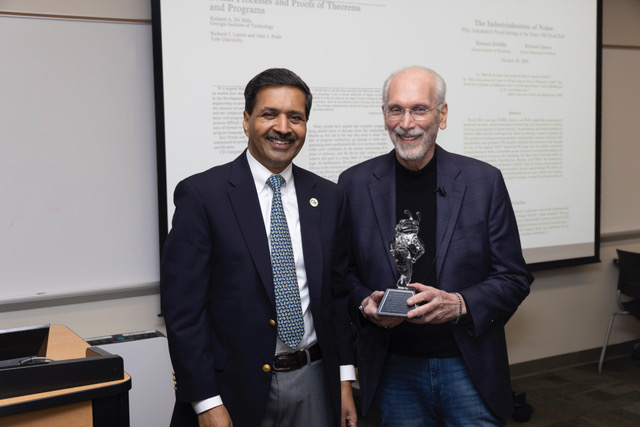
His extraordinary breadth of experience spans academia, industry, and government—including leadership roles at HP, Bellcore/Telcordia, and NSF—along with influential contributions to software engineering, cybersecurity, secure elections, and the future of higher education. Throughout it all, Rich has been a bold, out-of-the-box thinker whose ideas and leadership have had a lasting impact at Georgia Tech and far beyond. It was especially fitting to recognize him as one of this year’s inductees into the College of Computing Hall of Fame.
Our Advisory Board met on October 22–23. Many thanks to the faculty and staff members who participated in the meeting and spent time with our board members. Several board members told me how much they appreciated the opportunity for one-on-one conversations with you and the chance to get a firsthand sense of the exciting work happening across our College.
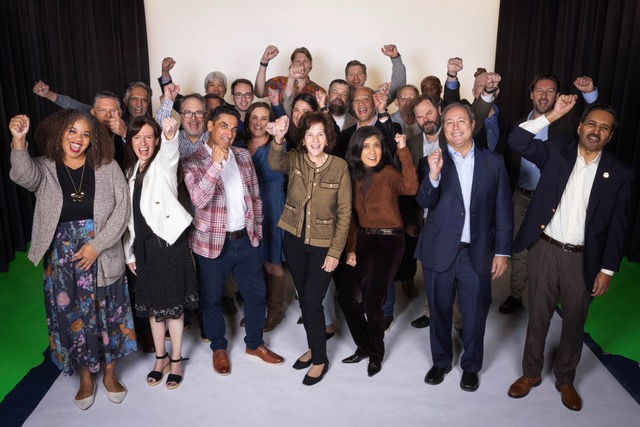
It was also wonderful to see so many of you at our College’s 2026 Hall of Fame celebration last Friday. We recognized three Rising Stars:
- Ali Foreman (CM 2017)
- Rushad Kaizad Heerjee (CS 2014; MS QCF 2017)
- Tamer Shaaban (CS 2011)
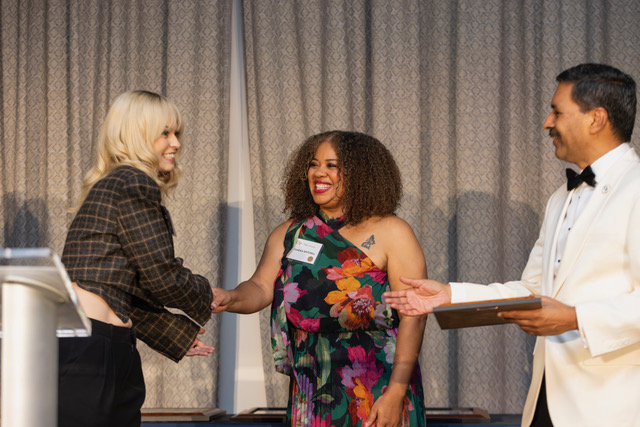
We also recognized five Distinguished Impact Award recipients:
- Bill Leahy (MS CS 1999)
- Mojgan LeFebvre (CS 1990)
- David Bright Leonard
- Joshua Silver (CS 2001)
- Sheetal Wrzesien (CS 1994, in memoriam).
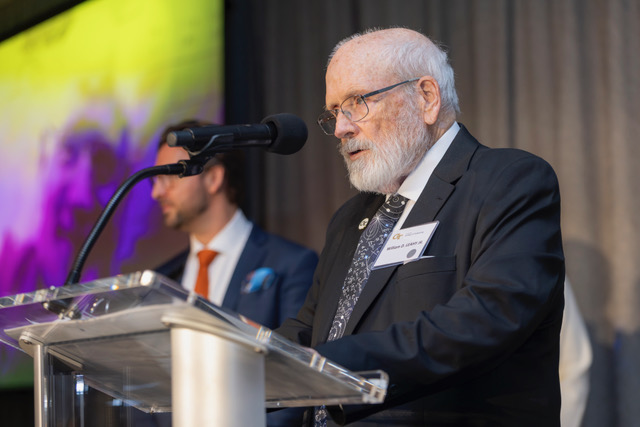
We also celebrated Eugene Spafford, a Hall of Fame inductee from a previous year, and three members of this year’s Hall of Fame class—Gregory Abowd, Rich DeMillo (PhD ICS 1972), and Paul Judge (MS CS 2001; PhD CS 2002).
Two additional members of this year’s class, Beth Mynatt (MS ICS 1989; PhD CS 1995) and Andy Ozment (CS 2000), were unable to attend, and we look forward to celebrating them in person at a future Hall of Fame event. It was a special treat to hear a few remarks from Peter Freeman during the celebration, observing how much our College has progressed since its founding in 1990.
Finally, a special thank you to our College’s Events, Communications, and Development teams, who worked tirelessly behind the scenes to make all of these events such great successes, especially with so many of them packed into such a short period of time.
Nexus Supercomputer
Georgia Tech celebrated the ribbon-cutting for the Nexus supercomputer on October 12 as part of Atlanta’s Avant South celebration. It was a major milestone for our Institute, and I want to highlight the central role that our College played in making Nexus a reality.
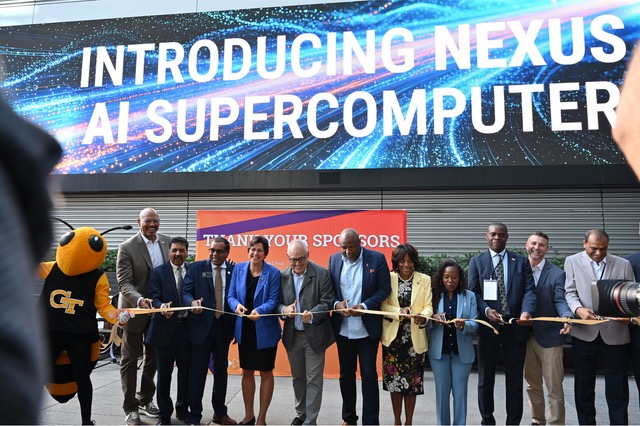
The proposal for Nexus was developed and submitted in Fall 2024 by the Center for Artificial Intelligence in Science and Engineering (ARTISAN) team. At the time, ARTISAN was part of the Institute for Data Engineering and Science (IDEaS), with Suresh Marru as its director, reporting to Srinivas Aluru in his role as IDEaS director. When Srinivas became Senior Associate Dean in our College in January 2025, the ARTISAN team members moved to GT Computing and continued reporting to Srinivas, while ARTISAN became a joint CoC–IDEaS center.
A key part of the Nexus proposal was a mutually beneficial partnership with the National Center for Supercomputing Applications (NCSA) at UIUC. NCSA has a long track record of securing major NSF computing infrastructure awards, while Georgia Tech had never before received an NSF award of this kind. So it was wonderful news when we learned in May 2025 that NSF had selected our proposal for funding. Nexus was one of only two awards made at this scale nationally. The other, awarded to UC San Diego, provides cloud computing resources to NSF researchers, making Nexus the only standalone supercomputer funded through these awards.
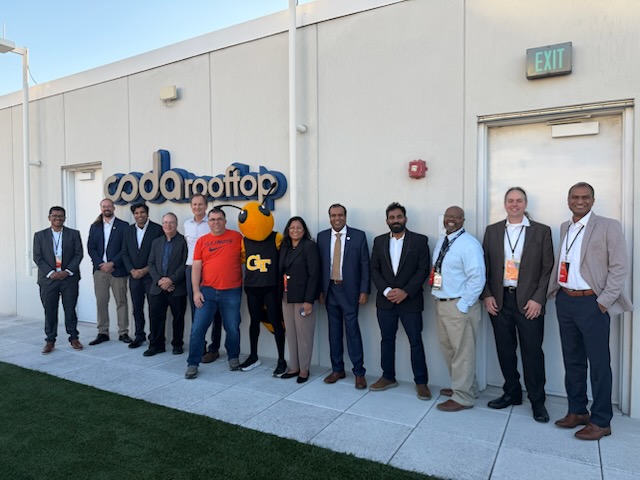
After the award was announced, the Georgia Tech team expanded to include staff from PACE and OIT more generally, who worked together to prepare for and assemble the system in the CODA data center. Despite the supply-chain and cost challenges involved in obtaining GPUs, memory, storage, and other components, Nexus came together on schedule and became operational this month. It is now supporting an initial set of projects from across the country as part of its deployment and testing, with broader access planned by the end of November.
Congratulations to Suresh, Srinivas, and the entire Nexus team on this tremendous accomplishment. See below for photos from the unveiling ceremony!
Leadership Announcement
I am pleased to announce that, following a rigorous search, Kelly Rockwell has been selected as the inaugural Senior Director of Strategic Initiatives and Operations for the College of Computing.
In this new role, Kelly will report directly to me and work closely with leaders across the College and all five Schools to develop new strategic initiatives and to help lead their implementation. I have seen an urgent need for this role since becoming Dean, as many College-wide strategic efforts have necessarily been absorbed by existing leaders on an ad hoc basis. That need is even greater now as we develop a new strategic plan and prepare to turn that plan into action.
As many of you know, Kelly has served as School Administrative Officer (SAO) for the School of Computer Science since 2019. During that time, she has made tremendous contributions to SCS, including reshaping its staff organization and helping build a positive culture for the school’s staff and broader community. She has also provided remarkable continuity and steady leadership through multiple transitions involving SCS chairs and interim chairs. Her commitment to the School and her consistent support for its faculty, staff, and students have made a lasting impact on strengthening the foundation of SCS.
Please join me in congratulating Kelly on this new role. I also encourage you to give her your full support when she reaches out to you as part of the projects she will be coordinating or leading. Kelly has also been added to the coc-dean-team@cc.gatech.edu mailing list.
Kudos
Finally, as always, I have lots of great news to share from across our community:
- Kamau Bobb (Constellations) was interviewed by WABE about his new book, The Bullwhip’s Algorithm: Artificial Intelligence and America’s Racial Caste System. Kamau discussed the connections among AI, public policy, education, and social systems. Congratulations, Kamau, and thank you for contributing your perspective and thought leadership to such a challenging and important topic for society!
- CBS News published a story about Nexus, our new NSF-sponsored AI supercomputer. In fact, Nexus generated a remarkable amount of media coverage, with stories from Atlanta News First, WSB, GPB, 11Alive, HPCWire, The Saporta Report, WRDW in Augusta, Scientific Computing, and Interesting Engineering.
- Gennie Mansi (PhD IC) and Mark Riedl (IC) published a paper in Nature Health examining gaps in legal accountability when AI tools used by insurers, state health departments, and care facilities harm patients. Congratulations to both of you, and thank you for shining light on the the negative impacts that AI tools can have on the humans they are intended to serve! AI Weekly also covered this research.
- Josiah Hester (IC) published an opinion piece in Communications of the ACM titled Who Owns the Wai (Water)? AI, Power and the Public Trust. Congratulations, Josiah, and thank you for contributing your perspective to this important discussion!
- Vijay Madisetti (SCP) has been selected to receive a Distinguished Alumnus Award from his alma mater, IIT Kharagpur—the university’s highest honor for alumni. Congratulations, Vijay, on this well-earned recognition!
- Vijay Madisetti (SCP) and Lorenzo de la Loza (MS CS 2026) wrote a paper featured by ACM in its Showcase on ACM Kudos, a public discovery page featuring plain-language explanations of computing research. Their paper, Interventions to Prevent Delusions from Excessive Use of Conventional Chatbots, demonstrates that anti-sycophancy prompting can reduce LLMs’ tendency to confirm users’ delusions by 73.8%. Congratulations, Vijay and Lorenzo, and thank you for your work on this important topic!
- MSN published a story about research co-authored by Bo Dai (CSE) describing a new benchmark that tests how well AI agents can engineer a functioning robot. The team also included Georgia Tech Machine Learning Ph.D. students Chenxiao Gao and Rushi Qiang. Congratulations to all!
- Karmesh Yadav (PhD IC), Yusuf Ali (PhD IC), and Zsolt Kira (IC) were featured on MSN for their work creating a benchmark to measure the memory capabilities of vision-language models. Congratulations to all, and thank you for helping advance the capabilities of in-home assistive robots!
- Bioengineer.org published an article about an algorithm developed by Sanne van Waveren (Postdoc IC), Zulfiqar Zaidi (PhD Robotics), and Matthew Gombolay (IC) that enables robots to learn to act in ways that make people more comfortable. Congratulations to all, and thank you for advancing our understanding of human-robot interaction!
- Fisayo Omojokun, our Associate Dean for Undergraduate Education, was quoted in an Associated Press story about the job market for computing graduates. Thank you, Fisayo, for highlighting our industry boot camps and the many opportunities our students have to build outstanding careers both within and beyond the technology sector!
- Frank Li (SCP) was quoted in a Yahoo Finance story about consent and privacy in recorded conversations. Congratulations, Frank, and thank you for sharing your expertise on this timely issue!
- Teodora Baluta (SCP) spoke with Cybersecurity Dive about her machine learning cybersecurity course. Thank you, Teodora, for showing how our curriculum continues to evolve with the rapidly changing world around us!
- Saman Zonouz (SCP) was featured in an article on Technology.org about the future of AI and the energy grid. Congratulations, Saman, and thank you for sharing your expertise on such a critical issue!
That’s all for this dispatch. There is so much happening across our College—and so much for all of us to take pride in. Thank you for everything you do to make it all possible, and I’ll talk to you soon.
Vivek